Why Did World War 1 Start? (Main Causes Explained Simply)
Most people learn the same answer in school. A man was shot in Sarajevo, and then somehow the whole world went to war. But if you stop and think about it for even a moment, that explanation makes no sense.
People get shot every day. Countries do not go to war over it.
So what actually caused World War 1? The real answer is far more interesting — and far more frightening — than a single bullet in Bosnia. Understanding what caused World War 1 means understanding how a whole continent of powerful nations managed to sleepwalk into the most destructive war the world had ever seen.
Let us go through it properly.
Why Did World War 1 Start?
World War 1 started because of a combination of long-term tensions and immediate triggers. Nationalism, alliances, militarism, and imperial rivalries created a fragile situation in Europe, while the assassination of Archduke Franz Ferdinand in 1914 acted as the spark that set the war in motion.
What Were the Main Causes of WW1?
The World Before 1914 — A Continent Sitting on Gunpowder
To understand the causes of World War 1, you first need to picture Europe in the years leading up to 1914. On the surface, things looked relatively stable. The great powers — Britain, France, Germany, Austria-Hungary, and Russia — had not fought a major war against each other for decades. There were even people who believed that modern economies had made large-scale war impossible. Countries were too interconnected, too dependent on trade, too rational to destroy themselves.
They were wrong. Underneath that surface, four enormous pressures had been building for years. Historians often summarize them as the MAIN causes: Militarism, Alliances, Imperialism, and Nationalism. Each one alone would have been manageable. Together, they created something almost impossible to stop.
Militarism — Everyone Was Building for War
By 1914, the major European powers had spent decades building up their armies and navies as fast as they could. Germany had massively expanded its military. Britain responded by building more battleships. France extended its military service requirements. Russia was modernizing its enormous army at a pace that genuinely frightened German generals.
This was not just about having weapons. The entire culture of the European ruling class had become militarized. Military officers were among the most respected people in society. War was spoken about in many circles not as a catastrophe to be avoided but as a test of national greatness — something almost inevitable, perhaps even desirable.
Military planners had spent years drawing up detailed war plans. Germany had the Schlieffen Plan — a strategy to fight France and Russia simultaneously by knocking out France first through Belgium. The problem with such detailed plans is that they become very hard to stop once events start moving. When the crisis of 1914 began, the machinery of mobilization was already oiled and ready. Military timetables started driving political decisions, not the other way around.
Alliances — The Trap That Caught Everyone
If militarism loaded the gun, the alliance system pulled the trigger.
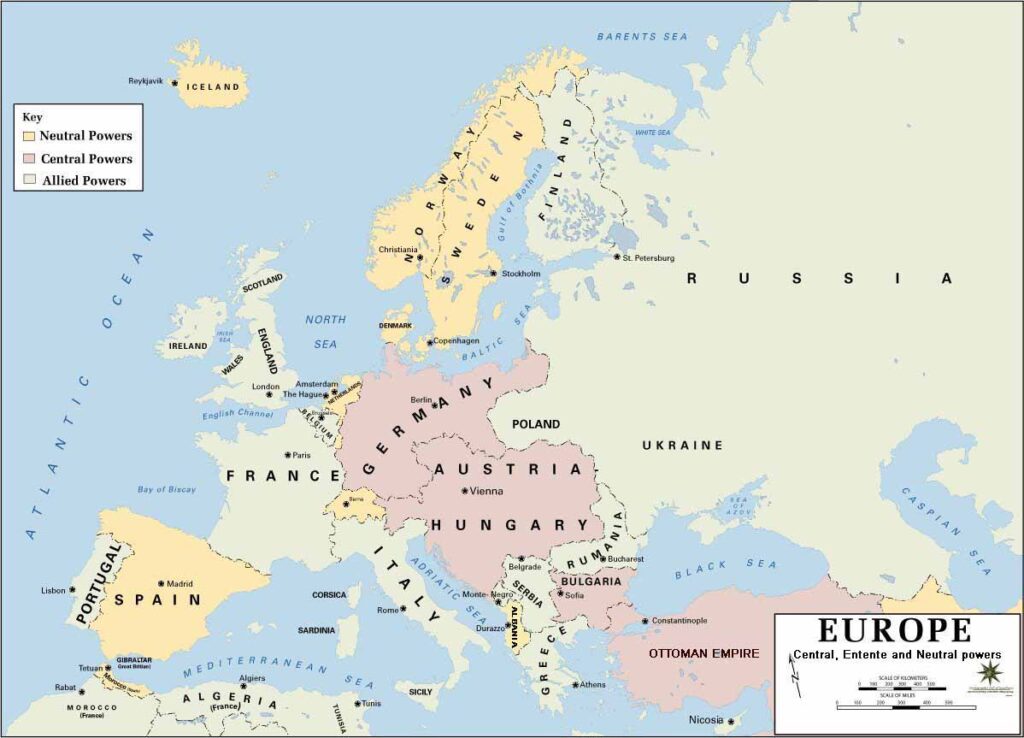
In the years before 1914, Europe had divided itself into two armed camps. On one side was the Triple Alliance — Germany, Austria-Hungary, and Italy. On the other was the Triple Entente — France, Russia, and Britain. These were mutual defense agreements. If one member was attacked, the others were obligated to help.
At the time, alliances seemed like a sensible way to keep the peace. If everyone knew that attacking France meant fighting Russia and Britain too, then nobody would dare start a war. It was a form of deterrence.
The flaw was that these alliances meant a conflict between any two countries could automatically drag in all the others. There was no circuit breaker. A dispute between Austria-Hungary and Serbia — which was, at its core, a regional argument in the Balkans — could pull in Russia, which would pull in Germany, which would pull in France, which would pull in Britain.
Which is exactly what happened.
Imperialism — A World Being Divided Up
By 1914, the European powers had carved up most of the world between them. Britain and France controlled enormous colonial empires. Germany, which had industrialized rapidly and become very powerful very quickly, felt that it deserved a larger share of global influence — what Kaiser Wilhelm II called Germany’s “place in the sun.”
This competition for colonies and influence had already produced several dangerous crises. The two Moroccan crises of 1905 and 1911 nearly brought France and Germany to war. Britain and Russia had spent decades competing for influence in Central Asia. Everywhere you looked, the great powers were pushing against each other.
Imperialism matters for understanding what caused World War 1 because it created a general atmosphere of rivalry and suspicion. Nations did not trust each other. Diplomats assumed the worst about each other’s intentions. When the crisis of 1914 began, there was very little goodwill left in the room.
Nationalism — The Force Nobody Could Control
Of all the causes of World War 1, nationalism was perhaps the most explosive.
The 19th century had seen nationalism — the idea that people sharing a language, culture, and history deserve their own independent state — sweep across Europe. It had already redrawn the map dramatically. Italy had unified. Germany had unified. And those unifications had been achieved through war.
But nationalism created a particular problem in Central and Eastern Europe, where the great empires — Austria-Hungary and the Ottoman Empire — ruled over dozens of different ethnic groups who increasingly wanted independence. The Balkans had become, in the famous phrase of the time, “the powder keg of Europe.”
Serbia was a small but ambitious state that dreamed of uniting all South Slavic peoples — including those living under Austro-Hungarian rule. Austria-Hungary was terrified of this idea. A successful South Slav state would encourage other ethnic groups within the empire to demand independence too. From Vienna’s perspective, Serbian nationalism was not just annoying — it was an existential threat.
This is why the assassination of Franz Ferdinand did not just cause outrage. It was the trigger Austria-Hungary had been looking for.
Was the Assassination the Only Cause?
The Spark — Sarajevo, June 28, 1914
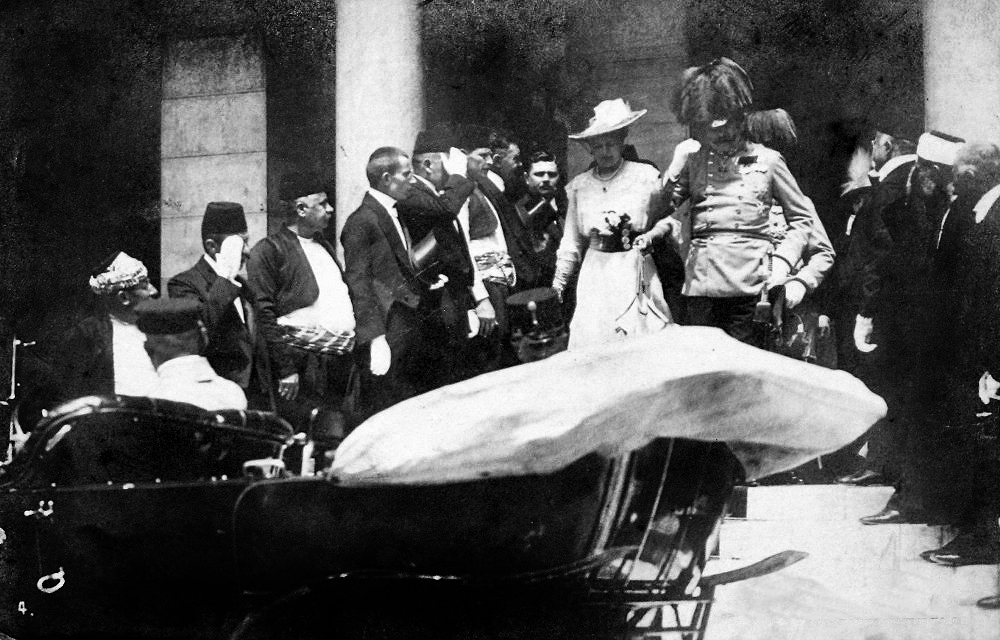
On June 28, 1914, Archduke Franz Ferdinand — heir to the throne of Austria-Hungary — was visiting Sarajevo, the capital of Bosnia, with his wife Sophie. Bosnia had only recently been annexed by Austria-Hungary, and resentment among the local Slavic population was deep.
A group of young Bosnian-Serb nationalists, connected to a secret society called the Black Hand, had come to Sarajevo with pistols and grenades.
The first assassination attempt that morning failed. A grenade thrown at the Archduke’s car bounced off and exploded under the following vehicle, injuring several people. The conspirators scattered. It looked like the plot had been foiled.
Then came one of history’s great accidents. After visiting the injured at the hospital, Franz Ferdinand’s driver took a wrong turn. He ended up on a narrow street called Franz Josef Street — and had to stop to turn around.
Standing on the pavement, not ten feet away, was nineteen-year-old Gavrilo Princip. He had given up on the morning’s plan and stopped for a sandwich.
Princip stepped forward and fired twice. Franz Ferdinand was hit in the neck. Sophie was hit in the stomach. Both died within an hour.
The July Crisis — How Six Weeks Ended an Era
The assassination was the spark. But what turned it into a world war was the six weeks that followed — a period historians call the July Crisis.
Austria-Hungary blamed Serbia for the assassination and saw it as a chance to crush Serbian nationalism once and for all. But Austria-Hungary could not act without knowing what Germany would do. When Austrian officials went to Berlin and asked for support, Kaiser Wilhelm gave what became known as the “blank check” — unconditional backing for whatever Austria-Hungary decided to do.
That decision changed everything.
Austria-Hungary issued Serbia an ultimatum with conditions designed to be rejected. Serbia accepted almost all of them — but not quite all. Austria-Hungary declared war on July 28. Russia, as the protector of Slavic peoples, began mobilizing its army. Germany demanded Russia stop. Russia refused. Germany declared war on Russia on August 1. France was allied with Russia, so Germany declared war on France on August 3.
To knock out France quickly using the Schlieffen Plan, Germany needed to march through neutral Belgium. Britain had guaranteed Belgian neutrality in a treaty from 1839. When German troops crossed the Belgian border on August 4, Britain declared war on Germany.
In six weeks, a regional dispute had become a world war. Every alliance had snapped into place like clockwork. Every military plan had been activated. Every diplomat who thought the crisis could be managed had been proven wrong.
So Who Was Actually to Blame?
Historians have argued about this question for over a century, and honest ones will tell you there is no clean answer.
Germany’s “blank check” to Austria-Hungary removed the last brake on escalation. Germany’s war plan required invading neutral Belgium, which was the direct cause of Britain entering the war. For these reasons, many historians place the heaviest responsibility on Germany and Austria-Hungary.
But the alliance system itself was a collective failure. Russia’s rapid mobilization closed off diplomatic options. France had encouraged Russia to stand firm. Britain’s position was ambiguous enough that Germany may have believed it would stay neutral.
Perhaps the most honest answer is this: the war was made possible by decades of competitive militarism, tangled alliances, imperial rivalry, and nationalist tension. The assassination was the match. But the gunpowder had been laid by an entire generation of European leaders who chose rivalry over diplomacy, military planning over political wisdom, and national pride over human life.
Nobody planned for a four-year war that would kill 20 million people. But nobody did enough to prevent it either.
Why This Still Matters
Understanding what caused World War 1 is not just a history exercise. It is a lesson in how great powers can stumble into catastrophe through a combination of fear, pride, miscalculation, and a failure to imagine how bad things can actually get.
Every generation believes it is too sophisticated, too modern, too connected for that kind of mistake.
The generation of 1914 believed that too.
Which cause do you think was the most important — the alliances, nationalism, or something else entirely? Share your thoughts in the comments below.
Leave a Reply