Life in the Trenches — What It Was Really Like
Imagine sleeping in a hole in the ground. The walls are mud. The floor is mud. Your boots have not been dry in three weeks. The man next to you died yesterday and nobody has been able to move him yet because the enemy sniper is still watching.
This was not an exceptional day in the trenches of World War 1. This was Tuesday.
Life in the trenches WW1 soldiers endured was so far beyond ordinary human experience that many veterans came home and simply never spoke about it. Not because they were hiding something dark — though they were — but because they genuinely could not find the words to explain it to people who had not been there.
This article tries to find those words.
How the Trench System Worked
The Western Front — the main battlefield between Germany on one side and France and Britain on the other — eventually stretched for about 700 kilometres, from the Belgian coast all the way to the Swiss border. Along this entire length, both sides had dug themselves into an elaborate network of trenches.
It was not simply one ditch. The system had multiple layers. At the front were the fire trenches — the ones closest to the enemy, where soldiers stood watch. Behind those were support trenches, where troops rested and reserves were held. Further back still were reserve trenches, supply depots, and command posts. Everything was connected by a zigzagging network of communication trenches running perpendicular to the front.
The trenches zigzagged deliberately. A straight trench would allow an enemy who broke through to fire along the entire length of it. A zigzag meant that even if the enemy entered your trench, they could only control one short section at a time.
Between the two opposing front lines lay No Man’s Land — a strip of devastated ground ranging from a few metres to several hundred metres wide. It was littered with shell craters, tangled barbed wire, the ruins of farms and villages that had once existed there, and the bodies of soldiers from both sides who could not be retrieved.
A Typical Day — If Any Day Could Be Called Typical
Contrary to what many people imagine, most days in the trenches did not involve dramatic battles. Long stretches of trench life WW1 soldiers experienced were defined not by combat but by grinding, relentless routine — punctuated by sudden, random violence.
The day began with Stand To.
An hour before dawn, every soldier in the fire trench had to be at his post, rifle ready, watching No Man’s Land over the parapet. Dawn was the most likely time for an enemy attack — the light was improving for the attackers but defenders could not yet see clearly. So every morning, without exception, soldiers stood in the cold and the mud and watched the darkness turn slowly grey.
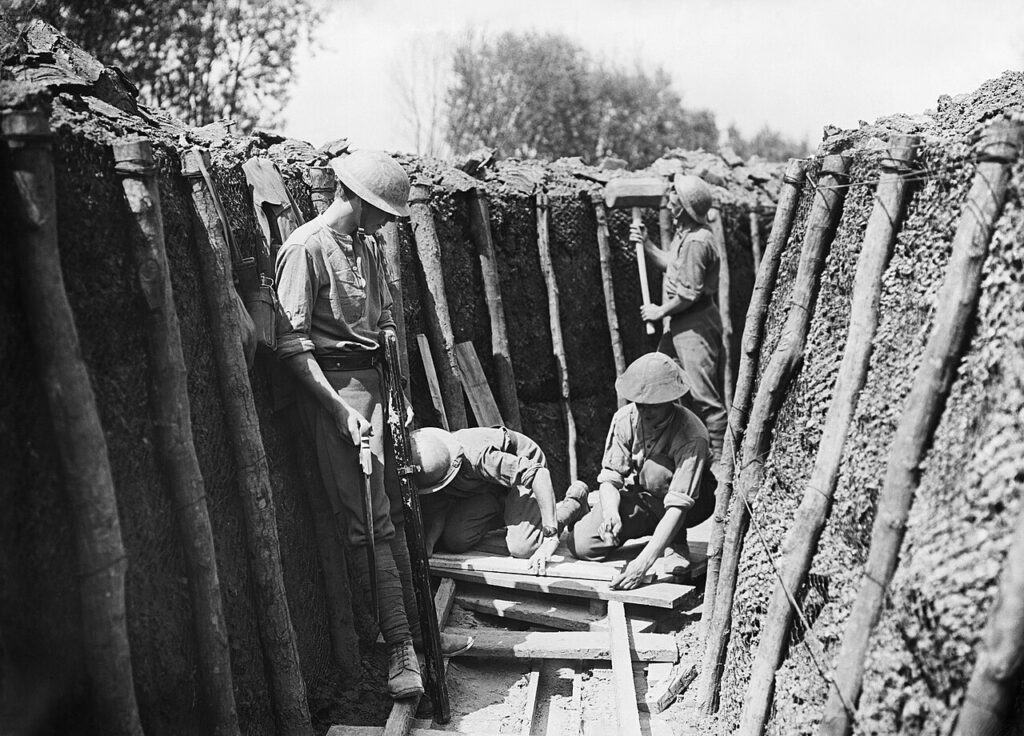
After Stand To came Stand Down. If no attack had come, soldiers were allowed to relax slightly — though never completely. They cleaned their rifles. They ate breakfast, if rations had arrived. They dealt with the endless maintenance work that trench life required — reinforcing walls that had collapsed overnight, draining water that had seeped in, replacing duckboards that had sunk into the mud.
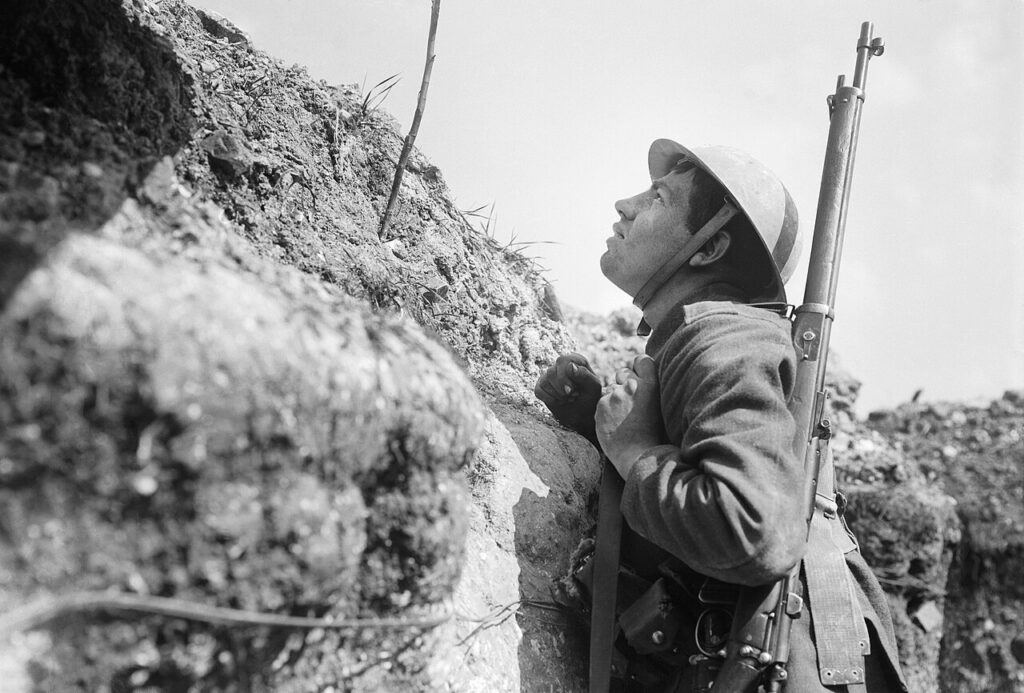
Then came the long hours of daylight, during which movement was extremely dangerous. Snipers on both sides watched constantly. Raising your head above the parapet at the wrong moment could be the last thing you ever did. So soldiers stayed low, moved carefully, and found ways to occupy the hours.
Some played cards. Some wrote letters home — carefully worded, because mail was censored. Some simply sat and tried not to think too much. Officers inspected equipment and wrote reports. Chaplains moved quietly through the trenches. The cook, if there was one nearby, produced something that technically counted as food.
In the evening came another Stand To at dusk — the second most dangerous time for attacks. After that, the real work of the night began.
The Night Shift
Darkness was when everything moved.
Supplies, ammunition, and food had to be brought up from the rear — it was too dangerous during daylight. Casualties had to be carried back. Repair parties went out to fix barbed wire or reinforce the parapet. Patrols crept into No Man’s Land to gather intelligence, cut enemy wire, or simply to demonstrate that your side was not afraid.
Patrols in No Man’s Land were among the most terrifying experiences a soldier could have. You crawled on your stomach through mud and shell craters, in near-total darkness, knowing that the enemy was doing the same thing somewhere out there. A sudden flare fired into the sky would illuminate everything — and you would freeze completely, trying to look like a dead man or a piece of broken equipment, until the light died and the darkness came back.
Sleep happened in fragments. Soldiers in the fire trenches might get three or four hours if they were lucky. There was no comfortable place to lie down. Dugouts — small chambers cut into the trench wall — offered some shelter from the weather but were damp, cramped, and home to rats in extraordinary numbers.
The Mud
Every account of life in the trenches WW1 soldiers wrote comes back to the mud. The Western Front ran through some of the most waterlogged land in Europe — particularly in Belgian Flanders, where the water table was just centimetres below the surface.
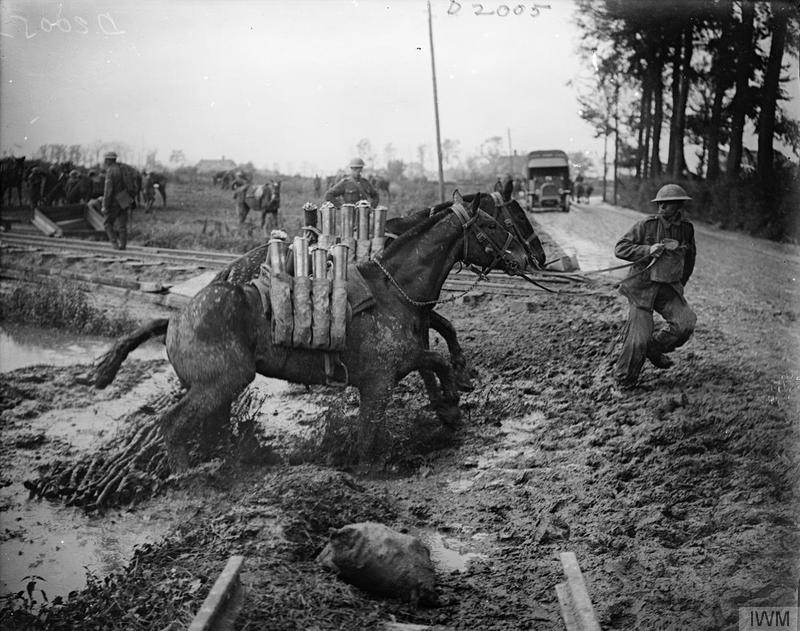
When artillery shells tore up the landscape — and by 1916 the landscape had been torn up many thousands of times over — the drainage systems of farms and villages were destroyed. The entire region became a vast, glutinous swamp. Rain made it worse. The constant passage of thousands of men, horses, and vehicles churned everything into a consistency that soldiers described as like grey glue — but heavier.
Men fell into shell craters filled with this mud and drowned before anyone could reach them. Horses disappeared into it up to their bellies. At Passchendaele in 1917, the mud became so deep and so pervasive that it defined the entire battle. One officer wrote that the ground was “neither liquid nor solid” — it simply consumed whatever entered it.
Trench foot was the medical consequence of standing in cold, wet mud for days without being able to remove your boots. The feet would swell, turn red, then blue, then black. In severe cases, gangrene set in and amputation was the only option. The army eventually made officers responsible for inspecting their men’s feet regularly and ensuring they were dried and treated with whale oil. Even so, the British Army alone suffered over 74,000 cases of trench foot during the war.
The Rats
The mud had competition for the title of most hated feature of trench life.
The rats were enormous — soldiers described them as being the size of cats, fattened on the food scraps and, more grimly, on the bodies of the dead that lay unburied in No Man’s Land and in the trench walls themselves. They came out at night in their thousands. They ran over sleeping soldiers. They ate rations that were not properly secured. They gnawed through equipment.
Soldiers developed elaborate systems for killing rats — flooding their burrows, using terrier dogs, setting traps. None of it made a lasting difference. The rats were simply part of life in the trenches WW1 soldiers had to accept, like the mud and the lice.
The lice were, if anything, even more ubiquitous than the rats. Almost every soldier on the Western Front had lice at some point. They lived in the seams of clothing and caused constant itching. Soldiers spent their rest periods “chatting” — the slang term for running a candle flame along the seams of their shirts to kill the eggs. It worked temporarily. Within days the lice were back.
Food — Officially and In Reality
The British Army had official daily ration standards that looked reasonably adequate on paper. A soldier was supposed to receive fresh meat, bread, vegetables, tea, sugar, and jam each day.
The reality depended entirely on where you were and what was happening.
When supply lines were working and the situation was quiet, food could be surprisingly decent. Field kitchens in the rear would prepare hot meals that were carried forward in containers — sometimes arriving still warm, sometimes arriving cold, sometimes not arriving at all because the carrying party had been hit by shellfire.
During active operations, hot food was often impossible. Soldiers subsisted on hard biscuits — thick, tooth-breaking squares that veterans joked could stop a bullet — tinned bully beef that tasted of nothing in particular, and whatever they could supplement from local sources. The tea was nearly constant. Whatever else was missing, the British soldier always seemed to have tea.
Water was a serious problem. Clean drinking water had to be transported forward in petrol cans — which gave it a distinctive taste that veterans apparently never forgot. Water found in shell craters or streams was potentially contaminated with everything from mud to rotting bodies to chemical weapon residue. Drinking it could be as dangerous as a bullet.
The Sound of the Trenches
People who have only read about trench warfare sometimes imagine it as primarily visual — the mud, the wire, the grey sky. Veterans consistently describe it as primarily auditory.
The guns were almost never completely silent. Artillery bombardments could last for days. The shells made different sounds depending on their size and trajectory — a distant thump as they left the enemy guns, a growing rushing or shrieking sound as they approached, then an explosion that could range from a sharp crack to a concussion that knocked men off their feet.
Men learned to read the sounds. Experienced soldiers could tell from the pitch and direction of an incoming shell roughly where it would land, and whether to flatten themselves into the mud or simply keep walking. New arrivals had not yet developed this skill. Their first days in the trenches were defined by constant flinching.
The constant exposure to artillery produced its own medical condition. Shell shock — now understood as a form of post-traumatic stress — affected hundreds of thousands of soldiers. Men would lose the ability to speak. They would shake uncontrollably. They would become paralysed by fear in situations that their conscious mind knew were not immediately dangerous. Many were treated with little sympathy by an army that did not yet understand what was happening to them.
Moments of Humanity
It would be wrong to describe trench life WW1 soldiers lived as nothing but misery. Human beings are remarkably good at finding meaning, connection, and even humour in terrible circumstances.
Soldiers formed deep bonds with the men in their units — bonds that many survivors described as the closest relationships of their lives. There were concert parties behind the lines — surprisingly professional theatrical performances that toured the rear areas. There was football, when the ground permitted. There were newspapers printed specifically for the troops, including the Wipers Times — a satirical paper produced by British soldiers in Ypres that was funny, irreverent, and remarkably sharp.
And there was the informal live-and-let-live system that developed spontaneously in many sectors of the front, where opposing soldiers would tacitly agree not to shoot during mealtimes, not to fire on working parties doing essential repairs, not to bombard latrines. It was never official. Commanders on both sides condemned it. But it was real, and it says something important about the men who lived in those trenches — that even in those conditions, they retained a stubborn, quiet humanity.
Coming Home
For soldiers who survived, the return to civilian life was often deeply disorienting.
The skills that kept you alive in the trenches — constant vigilance, the ability to sleep anywhere, emotional detachment from death — were not useful in peacetime. The bonds of the unit were gone. The intensity of that life, for all its horror, had been real in a way that ordinary life struggled to match.
Many veterans never spoke about what they had seen. Some spoke of nothing else. Some found ways to process it through writing, art, or community. Many simply carried it quietly for the rest of their lives.
Life in the trenches of WW1 lasted, for some soldiers, the entire war — four years of mud, noise, rats, cold, boredom, and sudden terror. The men who lived it were not extraordinary to begin with. They were farmers, teachers, factory workers, and clerks who found themselves doing something no human being should ever have to do.
They deserve to be remembered properly.
What part of trench life surprised you most? Let me know in the comments — and if you found this article interesting, the story of what soldiers ate in the trenches goes even deeper into the daily reality of life on the Western Front.
2 responses to “Life in the Trenches — What It Was Really Like”
-
[…] return to fighting in the trenches was, by many accounts, deeply […]
-
[…] of the system? Leave your thoughts in the comments. And if you want to understand what daily life inside the trenches was actually like for the men who lived there, the full story of life in the trenches goes deeper […]
Leave a Reply