The Christmas Truce of 1914 — Did It Really Happen?
On the night of December 24, 1914, a British soldier peered over the edge of his trench and saw something that made no sense.
Lights. Small, flickering lights, appearing one by one along the German trenches on the other side of No Man’s Land. At first he thought it was some kind of signal, or perhaps a trick. Then he heard it — voices, carrying across the frozen mud in the cold night air, singing.
Stille Nacht. Heilige Nacht.
Silent Night. Holy Night.
What happened next over the following 24 hours became one of the most famous and most debated moments in the history of warfare. The Christmas Truce of 1914 — the spontaneous, unauthorized, and utterly human decision by soldiers on both sides to simply stop fighting for one day — has been told and retold for over a century. It has been made into films, commemorated in monuments, referenced in speeches about peace.
But what actually happened? How widespread was it really? Who started it? And what does it tell us about the men who lived and died in those trenches?
Let us find out.
The World in December 1914
To understand the Christmas Truce, you first need to understand the state of the war by the end of 1914 — because it was not at all what anyone had expected.
When the war began in August 1914, both sides believed it would be over quickly. German soldiers wrote “home before the leaves fall” on their kit bags. British volunteers were told they might not see any action at all before the whole thing was wrapped up. The general assumption, on every side, was that modern industrial warfare would be so overwhelming that neither side could sustain it for long.
They were catastrophically wrong.
By December 1914, the Western Front had already settled into the grinding stalemate of trench warfare. Hundreds of thousands of men were already dead. The grand sweeping campaigns of the opening months had collapsed into a static line of muddy ditches stretching from the Belgian coast to the Swiss border. Nobody was going anywhere.
The men in those trenches had been living in extraordinary close proximity to the enemy for months. In some sectors, the opposing trenches were separated by less than 50 metres — close enough to hear someone coughing on the other side, close enough to smell their cooking. Over weeks and months, an informal and entirely unofficial set of understandings had developed in many sectors. You do not shell our cook, we will not shell yours. You do not fire on our working parties at night, we will not fire on yours.
This was the atmosphere into which Christmas 1914 arrived. The war was young enough that the deep, propaganda-fuelled hatred of later years had not yet fully taken hold. The men on both sides were cold, exhausted, and homesick. And it was Christmas.
The Night It Began — Christmas Eve, 1914
It started with the trees.
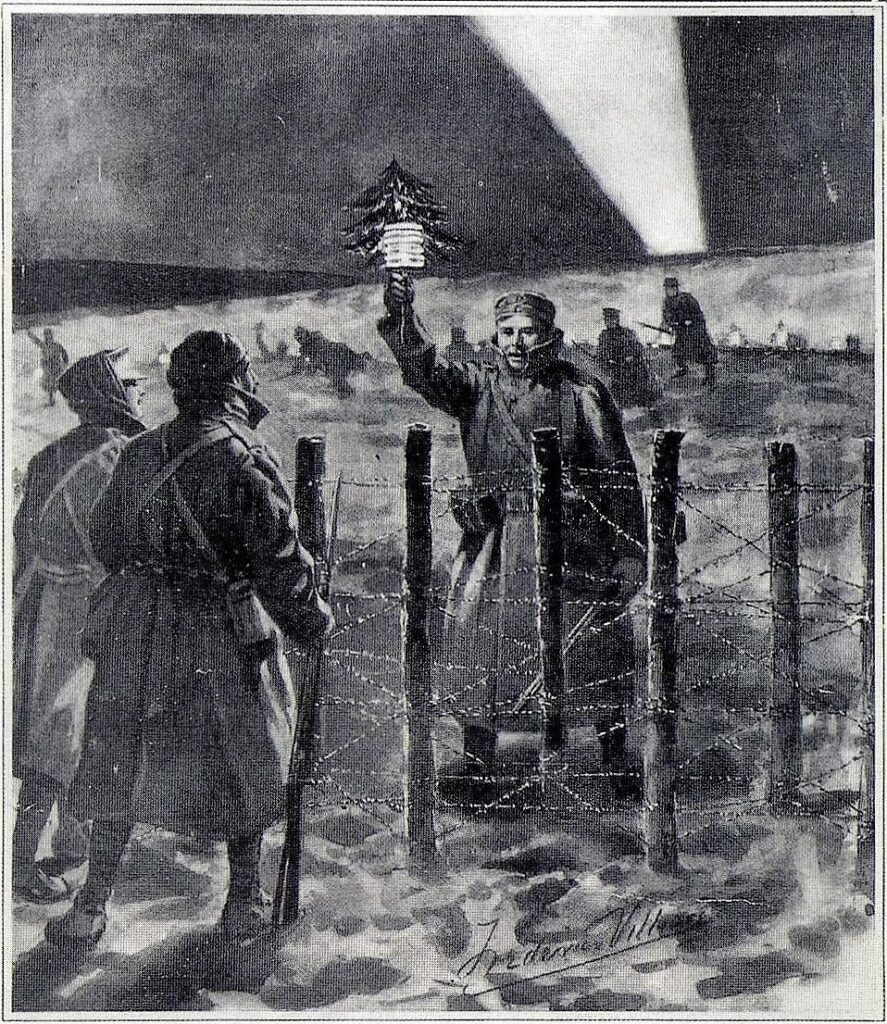
German soldiers had received Christmas trees — small ones, with candles — as part of their holiday rations. On Christmas Eve, they began placing them along the tops of their parapets, lighting the candles, and singing. The sight was so unexpected, so incongruous against the backdrop of mud and barbed wire and everything the previous months had brought, that British soldiers simply stared.
Then they started singing back.
Private Albert Moren of the 2nd Queens Regiment described looking over his parapet and seeing “the most extraordinary sight I have ever witnessed” — the German line lit up with what looked like hundreds of small lanterns, and the unmistakable sound of carol singing drifting across No Man’s Land.
In some sectors, it went no further than that — songs exchanged in the darkness, a few shouted greetings, and then silence. But in others, something more remarkable happened.
Men started climbing out of their trenches.
Into No Man’s Land
The first to come out were usually the bravest — or perhaps the most reckless. A German soldier would appear above the parapet, hands clearly visible, calling out in broken English. A British soldier would climb out to meet him. And then, one by one, more men from both sides would emerge from their trenches and walk into the strip of ground that, just hours before, would have been a death sentence to enter.
They shook hands. They exchanged gifts — German soldiers had received good supplies of tobacco, sausage, and schnapps for Christmas. British soldiers had plum pudding, biscuits, and cigarettes. These were swapped with the enthusiasm of men who had been eating the same monotonous rations for months.
There were language barriers, of course — most of the communication happened through gestures, the universal language of pointing and laughing, and whatever handful of words each side knew from the other’s language. But communication happened. Private William Tapp wrote home that he had spoken for over an hour with a German soldier who turned out to be a barber from Stuttgart, who had a wife and two children, and who was no more enthusiastic about the war than Tapp himself was.
Photographs were taken. Several survive. They show British and German soldiers standing side by side in No Man’s Land, some with their arms around each other’s shoulders, some grinning at the camera. These photographs are among the most extraordinary documents of the entire war — visual proof that this was not a legend but a real thing that happened on a cold December morning in Flanders.
The Football Games
No aspect of the Christmas Truce has captured the imagination more than the football games allegedly played between British and German soldiers in No Man’s Land.
The truth, as with most legends, is more complicated than the simple version.
There is solid evidence that informal kickabouts happened in multiple locations — soldiers kicking a tin can, a bundle of rags, or an actual football around in the mud between the trenches. Captain Sir Edward Hulse of the Scots Guards wrote a detailed letter to his mother describing exactly this — a spontaneous game that he watched with something between astonishment and delight.
Whether these were organized matches with goalposts and referees and a final score, as some later accounts suggest, is much harder to verify. The ground in most sectors was pitted with shell craters and covered in mud and debris — not ideal for football. And soldiers were not exactly in peak physical condition after months in the trenches.
What is accurate is this — men played. It may have been informal, it may have been chaotic, it may have lasted twenty minutes rather than ninety. But in the ruins of No Man’s Land, on Christmas Day 1914, some version of football happened. And that fact, simple as it is, carries an emotional weight that nothing else about this story quite matches.
How Widespread Was It Really?
This is the question historians have spent decades trying to answer precisely.
The honest answer is that the Christmas Truce of 1914 was widespread but not universal. It happened across many kilometres of the British-German front — primarily in the sectors held by British and German troops in Belgium and northern France. Hundreds of separate accounts, letters, and diary entries confirm it in dozens of different locations.
But it did not happen everywhere. In some sectors, the truce was explicitly rejected. Soldiers who attempted to climb out of their trenches in these areas were fired upon. There are documented cases of British officers forbidding any contact with the enemy, and of German officers doing the same. The French Army, fighting on a different section of the front, largely did not participate — their experience of German invasion of their own soil made the idea of fraternizing with the enemy far less appealing.
It is also important to note that the truce was entirely spontaneous and entirely unofficial. No general ordered it. No government sanctioned it. It emerged from the bottom up — from the decisions of individual soldiers who, in the absence of orders telling them what to do on Christmas Eve, simply chose to be human.
That is perhaps the most remarkable thing about it.
What the Soldiers Said — In Their Own Words
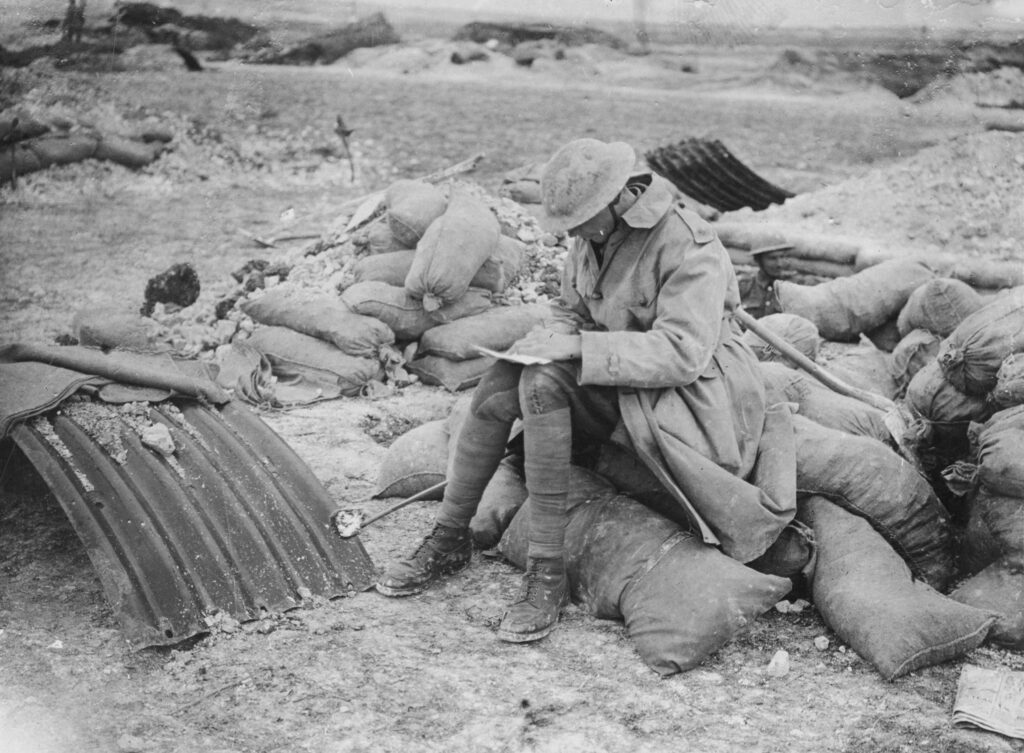
The best evidence for the Christmas Truce comes from the letters soldiers wrote home in the days immediately afterwards — private correspondence that was not intended for publication, written by men trying to describe something they themselves could barely believe.
Captain Sir Edward Hulse wrote one of the most detailed accounts. In a long letter to his mother, he described going out into No Man’s Land on Christmas morning, meeting German officers, shaking hands, and then spending several hours arranging an informal truce during which both sides buried their dead, exchanged gifts, and talked as best they could.
He described the German soldiers as “extraordinarily fine men” — physically impressive, friendly, and apparently just as baffled by the whole situation as he was. He noted that many of them spoke some English, having worked in England before the war as waiters, barbers, and hotel staff. One German officer told him he hoped the war would be over soon and that they could all go home. Hulse agreed.
Private Henry Williamson, who would later become a famous nature writer, wrote to his mother that he had shaken hands with the enemy and felt “a queer thrill.” He found it almost impossible to express what the experience had felt like — the sudden, jarring realisation that the men on the other side of the wire were not monsters but people.
A German soldier named Josef Wenzl wrote in his diary that he had exchanged schnapps for English chocolate, and that the whole experience felt “like something out of a dream.” He wrote that he could not imagine going back to trying to kill the same men he had just spent Christmas with.
He did, of course. They all did.
Christmas Day — And Then It Was Over
The truce lasted different lengths of time in different places. In some sectors it was a single night — by Christmas morning, things were back to normal. In others it extended through Christmas Day and even into December 26. In a handful of documented cases, the informal ceasefire lasted into the new year before officers on both sides finally reasserted control.
The return to fighting in the trenches was, by many accounts, deeply difficult.
Henry Williamson described it as one of the hardest things he had ever experienced — having to go back to treating as enemies men he had just sat and talked with. One British officer wrote in his diary that he felt physically sick when ordered to resume offensive operations against men he had spent Christmas with. He obeyed, because that was what soldiers did. But he remembered it.
The military authorities on both sides were largely unhappy about what had happened. Not universally — some commanders expressed quiet admiration for the humanity their men had shown. But the official view was that fraternizing with the enemy was dangerous to military discipline and potentially treasonous. Orders were issued making clear that any repetition would result in court martial.
The truce did not change the deeper causes of the war.
Did It Happen Again?
Smaller, more localized truces did occur in subsequent Christmases — in 1915, 1916, and even 1917. But nothing on the scale of 1914 was ever repeated.
By Christmas 1915, the war had changed. The battles of 1915 — the gas attacks at Ypres, the slaughter at Loos, the failed offensives on both sides — had hardened attitudes. The propaganda machines of both sides had been working for a full year, and the enemy had become more genuinely alien in the minds of soldiers. The informal live-and-let-live agreements that had made the 1914 truce possible were actively suppressed by commanders who had learned from the previous year.
By 1916, after the Somme and Verdun, the Christmas Truce of 1914 probably felt to many survivors like something that had happened in another war entirely. In a sense, it had.
Why Does This Story Still Matter?
The Christmas Truce of 1914 has been told so many times that it risks becoming a kind of comfortable myth — a story we tell ourselves about the essential goodness of human beings that allows us to feel better about an event that was, in almost every other respect, a catastrophe.
That would be a mistake.
The Christmas Truce matters not because it proves that war is secretly not that bad, or that enemies are really friends underneath. It matters because it proves something harder and more uncomfortable — that ordinary people can recognize each other’s humanity even in the most dehumanizing circumstances imaginable, and that this recognition is not enough to stop the killing.
The men who shook hands in No Man’s Land on Christmas Day 1914 went back to their trenches and kept fighting for another four years. Many of them died. The war they were part of killed twenty million people. The peace that followed it was so badly constructed that it made another world war almost inevitable.
The Christmas Truce did not change any of that. What it changed was one day. One cold December day when men who had been trained to kill each other decided, without being told to, without any authority behind them, simply to stop.
That is not a comfortable story. It is a true one.
And true stories, even the ones that do not end well, are worth remembering.
Does the Christmas Truce make you feel hopeful — or does it make the rest of the war feel even more tragic? Leave your thoughts in the comments below. And if this story moved you, the full story of life in the trenches goes even deeper into what these men endured every single day.
Leave a Reply