The Eastern Front Explained — The Forgotten War of World War 1
Most people who know anything about World War 1 know about the Western Front.
They know about the trenches of Flanders. They know about the Somme and Verdun. They know about the mud and the machine guns and the Christmas Truce and the poets who wrote about dying in foreign fields.
What most people do not know — what most history lessons, most documentaries, and most popular accounts of the war leave almost entirely unaddressed — is that there was another front. A front that was longer, more mobile, and in many ways more consequential than anything that happened in Belgium or France. A front that stretched 1,600 kilometres from the Baltic Sea to the Black Sea. A front where empires collapsed, revolutions ignited, and the political map of the entire 20th century was drawn in blood.
The Eastern Front of World War 1 is the forgotten war. Forgotten in the West, at least — in Russia, in Poland, in the countries that were once Austria-Hungary, the memory of the Eastern Front runs very deep indeed.
This is its story.
The Stage — Geography and Scale
To understand the Eastern Front, you first need to understand the geography.
The Western Front, as we have seen, was approximately 700 kilometres long. It was fixed — static — from the autumn of 1914 until the final weeks of the war. Its defining characteristic was immobility.
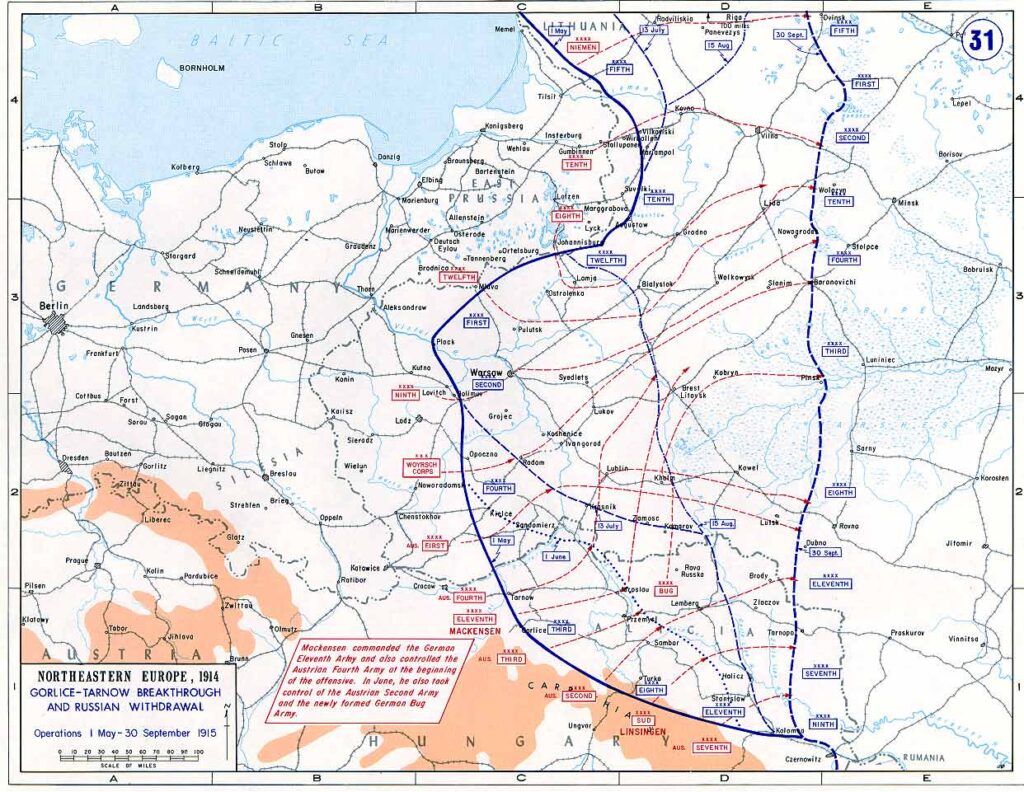
The Eastern Front was more than twice as long — stretching approximately 1,600 kilometres from the Baltic Sea in the north through what is now Poland, Ukraine, and Romania, all the way to the Black Sea coast in the south. And unlike the Western Front, it moved. Sometimes dramatically, sometimes catastrophically, the lines on the Eastern Front shifted back and forth across hundreds of kilometres over the course of the war.
Why the difference? Several reasons, all connected.
The Eastern Front was simply too long to be held by a continuous system of deep, mutually reinforcing trenches of the Western Front type. The density of troops per kilometre of front was dramatically lower than in the West — there were not enough men on either side to fill every metre with soldiers and machine guns. Gaps existed. Flanks could be turned. Movement was possible.
The terrain also differed. The Eastern Front crossed the vast plains of Poland and western Russia — flat, open ground that favoured maneuver rather than static defence. There were rivers — the Vistula, the Dnieper, the Dniester — that provided natural defensive lines, but they could be crossed. There were forests and marshes that channelled movement but did not stop it.
And the infrastructure was different. The road and railway networks of eastern Europe in 1914 were far less developed than those of France and Belgium. This made supply and reinforcement slower and more difficult for both sides — but it also meant that the kind of sustained, industrial-scale bombardment that characterized the Western Front was harder to maintain. The Eastern Front was, in some ways, an older kind of war — still terrible, still devastating, still industrial in its killing — but with a fluidity that the Western Front entirely lacked.
The Powers — Who Was Fighting Whom
The Eastern Front was not a simple two-sided conflict. It involved three major empires facing each other across a vast landscape, with smaller nations caught in between.
On one side were the Central Powers — primarily Germany and Austria-Hungary, with Bulgaria joining in 1915 and the Ottoman Empire engaged on the related Caucasus Front further south.
On the other side were the Allied Powers — primarily Russia, with Romania joining in 1916 and suffering catastrophically for doing so.
The Russian Empire in 1914 was the largest country in the world — stretching from Eastern Europe across Siberia to the Pacific. Its army — the famous Russian steamroller — was the largest in the world by number of men. Russia had approximately 1.4 million men under arms in peacetime and could mobilize millions more through conscription.
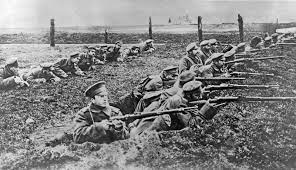
But size was not everything. The Russian army of 1914 was, in many respects, not ready for the kind of war it was about to fight. Its officer corps was a mixture of capable professionals and aristocratic incompetents appointed more for social connections than military ability. Its supply system was inadequate for the demands of modern industrial war — in the early months, some Russian units went into battle with one rifle for every three men, expecting to pick up weapons from the dead. Its communications were so poor that Russian radio messages were sometimes sent in plain language because there were not enough code books — allowing German intelligence to read Russian operational plans in real time.
Against Russia stood Germany — the most technically and militarily sophisticated army in the world in 1914 — and Austria-Hungary — a sprawling, multi-ethnic empire whose army was brave but poorly led and chronically undersupplied.
The interaction of these three very different military machines, across a vast and varied landscape, produced a war that looked completely different from anything happening on the Western Front.
The Opening — Tannenberg and the Masurian Lakes
Germany’s strategic problem in 1914 was the two-front war it had always feared — France to the west, Russia to the east. The Schlieffen Plan was built on the assumption that Russia would be slow to mobilize — giving Germany time to knock out France in the west before turning its full strength east.
Russia mobilized faster than Germany expected. By late August 1914, two Russian armies — the First Army under General Paul von Rennenkampf and the Second Army under General Alexander Samsonov — had invaded the German province of East Prussia, threatening territory that the German High Command considered psychologically and politically vital to defend.
Germany responded by rushing forces east under two commanders who would become the dominant figures of the German Eastern Front — General Paul von Hindenburg, brought out of retirement, and his Chief of Staff General Erich Ludendorff. Working at extraordinary speed, exploiting both excellent railway networks and the intelligence gift of Russian radio transmissions sent in plain language, they devised a plan to deal with the two Russian armies separately before they could combine.
The Battle of Tannenberg, fought from August 26 to 30, 1914, was one of the most decisive battles of the entire war. German forces encircled the Russian Second Army. Of the approximately 150,000 men of Samsonov’s army, about 92,000 were taken prisoner. The rest were killed, wounded, or scattered. General Samsonov, facing capture and the full weight of the catastrophe, walked into a forest and shot himself.
The Battle of the Masurian Lakes, fought immediately afterward in September 1914, drove the Russian First Army out of East Prussia. Russia had lost two armies in less than a month.
The Eastern Front had announced itself with a catastrophe of a scale that the Western Front would not see until the Somme in 1916.
The Austrian Disasters — A Crumbling Empire
While Germany was winning spectacular victories against Russia in the north, its ally Austria-Hungary was experiencing spectacular disasters in the south.
Austria-Hungary’s opening campaign against Serbia — the small Balkan nation that Austria-Hungary held responsible for the assassination of Franz Ferdinand — was a humiliating failure. The Serbian army, battle-hardened from the Balkan Wars of 1912 and 1913, inflicted three successive defeats on Austro-Hungarian forces in the opening months of the war. An empire of 50 million people with one of the largest armies in Europe was being repeatedly beaten by a nation of 4 million.
The situation on the Galician Front — where Austria-Hungary faced Russia — was equally disastrous. In the opening weeks of the war, Russian forces advanced deep into the Austro-Hungarian province of Galicia — modern-day Ukraine and southern Poland — capturing the major city of Lwów and advancing toward the Carpathian Mountains. Austria-Hungary lost approximately 400,000 men in the first months of fighting — an irreplaceable core of professional officers and experienced soldiers whose loss fatally weakened the empire’s military capacity for the rest of the war.
The pattern that would define Austria-Hungary’s war was established early. The army was courageous but chronically short of equipment, ammunition, and competent senior leadership. Its multi-ethnic character — soldiers who spoke a dozen different languages and came from a dozen different national traditions — was both its greatest potential strength and its greatest weakness. When the war went well, the empire’s diversity produced adaptable, resilient soldiers. When it went badly, the cracks between nationalities — Czechs, Hungarians, Croats, Poles, Slovenes, Austrians — widened into fractures.
Germany repeatedly had to send forces to shore up the Austro-Hungarian front — at enormous cost to its own operational freedom. The phrase that became current among German officers — “we are shackled to a corpse” — was cruel but not entirely unfair.
1915 — The Great Retreat
The year 1915 on the Eastern Front belonged to Germany.
In a series of coordinated offensives from spring through autumn, German and Austro-Hungarian forces pushed the Russian armies back across vast distances. The Gorlice-Tarnow Offensive of May 1915, planned by German General August von Mackensen, broke through the Russian lines in Galicia and triggered what became known as the Great Retreat — a withdrawal of Russian forces across hundreds of kilometres of territory, including the historic Polish cities of Warsaw, Vilna, and Brest-Litovsk.
The Great Retreat was one of the most dramatic military events of the war. Russian forces, running desperately short of artillery shells and rifles — the industrial production of the Russian empire could not keep pace with the demands of modern war — fell back across the vast plains of Poland and western Russia. They practiced scorched earth tactics as they went — burning crops, destroying infrastructure, driving civilian populations ahead of them to deny resources to the advancing Germans.
The human cost of the Great Retreat was staggering. Military casualties were enormous. But the civilian cost may have been even greater. Millions of people — Jews, Poles, Ukrainians, Belarusians — were driven from their homes in a massive forced displacement that prefigured the population movements of World War 2. Jewish communities in particular were subjected to violence, expulsion, and massacre by Russian military authorities who regarded them with deep suspicion as potential German sympathizers.
By the end of 1915, Russia had lost the entirety of the territory it had held in Poland and much of what it had held in Galicia. It had suffered approximately 2 million casualties in that year alone. The Russian army was still enormous — Russia could replace bodies, however inadequately equipped — but its capacity for offensive action had been severely damaged.
1916 — The Brusilov Offensive
In the summer of 1916, one of the most brilliant military operations of the entire war was launched on the Eastern Front — and almost nobody in the West has heard of it.
General Aleksei Brusilov was an unusual figure in the Russian army — a professional soldier of genuine talent who had thought carefully about the tactical problems the war had created and developed innovative solutions to them. Where most commanders on both the Eastern and Western Fronts launched attacks on narrow fronts preceded by prolonged bombardments that sacrificed surprise, Brusilov proposed something different.
His plan called for attacks on a broad front — simultaneously, at multiple points — making it impossible for the enemy to concentrate their reserves to plug any single breakthrough. Each attacking point would be preceded by a short, intense bombardment rather than a prolonged one, preserving surprise. Troops would be concentrated in forward positions, close to the enemy lines, to minimize the time they spent crossing the open ground between trenches.
The Brusilov Offensive, launched on June 4, 1916, achieved results that astonished the military world. In the first days, Austro-Hungarian lines collapsed across a front of more than 300 kilometres. Within weeks, Brusilov’s forces had advanced up to 60 kilometres in some sectors, capturing approximately 400,000 prisoners. It was the most successful Allied offensive of the entire war — measured by territory gained and prisoners taken.
The Brusilov Offensive had consequences far beyond the Eastern Front. It forced Germany to divert forces from the Somme — reducing the pressure on the British offensive that was already grinding through its terrible early weeks. It persuaded Romania to enter the war on the Allied side in August 1916 — a decision Romania would regret deeply when Germany and Austria-Hungary responded by overrunning most of the country within months.
And it demonstrated, for anyone paying attention, that the tactical stalemate of the World War 1 battlefield was not unbreakable — that innovative thinking, properly applied, could achieve results that years of conventional attacks had failed to produce. The lessons of the Brusilov Offensive — broad front attacks, short intense bombardments, surprise, deep penetration — were absorbed by military planners on both sides and reappeared, in evolved form, in the tactics that ended the war in 1918.
Brusilov himself paid a heavy price for his success. The offensive cost Russia approximately 500,000 casualties — losses that, combined with everything Russia had already suffered, pushed the Russian army toward the breaking point it would reach in 1917.
1917 — Revolution and Collapse
The year 1917 transformed the Eastern Front — and the entire war — through events that nobody had fully anticipated.
By the beginning of 1917, the Russian army had suffered approximately 5 to 6 million casualties since the start of the war — killed, wounded, and taken prisoner. The Russian civilian population was suffering from food shortages, fuel shortages, and the accumulated exhaustion of nearly three years of total war. The government of Tsar Nicholas II — never particularly effective or popular — had been further discredited by its management of the war effort, the influence of the mysterious figure of Rasputin at court, and a series of political scandals that had eroded public confidence.
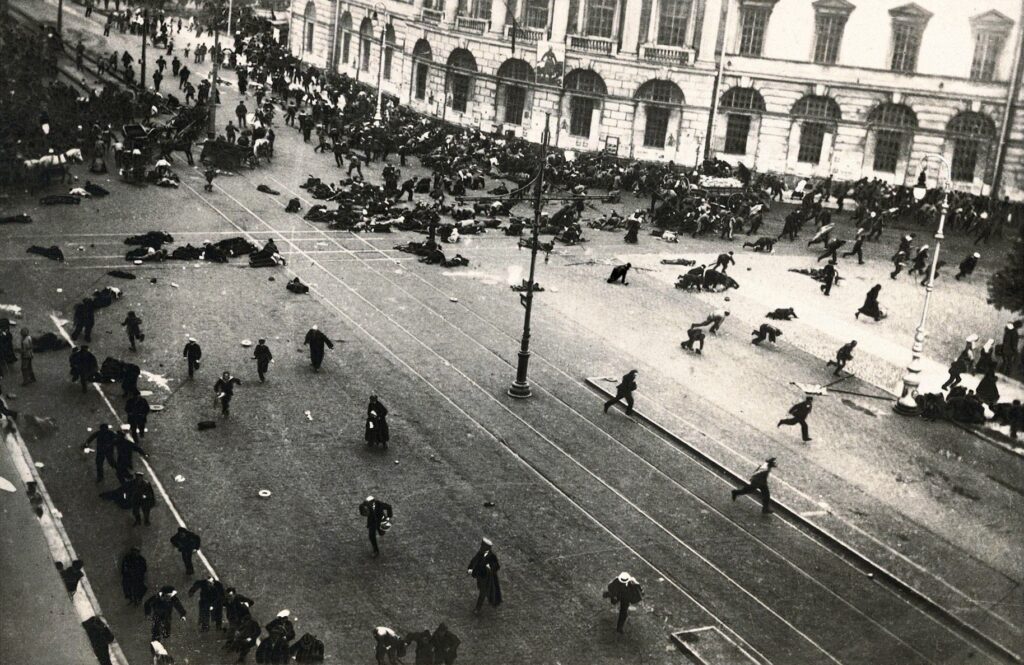
In February 1917, revolution broke out in Petrograd — the Russian capital, renamed from the German-sounding St. Petersburg at the start of the war. Bread riots escalated into a general strike. Military units sent to suppress the protests instead joined them. The Tsar, isolated and politically paralysed, abdicated on March 2, 1917.
The Provisional Government that replaced him made a decision that sealed its own fate — it would continue fighting the war. This decision was partly driven by obligations to the Allied powers, partly by fear of what a separate peace would mean for Russia’s international position, and partly by genuine belief among some members that only military victory could secure Russia’s democratic future.
The Russian army, which had been holding together through a combination of discipline and hope that conditions would improve, began to collapse. Soldiers who had endured three years of catastrophic losses, inadequate supply, and incompetent leadership were asked to keep fighting for a government that had not yet proven itself. The Bolshevik Party, led by Vladimir Lenin — who had been transported from exile in Switzerland to Russia in a sealed train by Germany, which correctly calculated that he would take Russia out of the war — promised the one thing most Russian soldiers desperately wanted. Peace, land, bread.
The October Revolution of 1917 brought the Bolsheviks to power. They immediately opened negotiations with Germany.
On March 3, 1918, Russia signed the Treaty of Brest-Litovsk — one of the most punishing peace settlements in modern history. Russia surrendered Finland, the Baltic states, Poland, Ukraine, and large portions of Belorussia and the Caucasus — approximately one-third of European Russia, one-third of its agricultural land, more than half of its industrial capacity, and approximately 55 million people. The Eastern Front ceased to exist.
What the Eastern Front Cost
The human cost of the Eastern Front was staggering — and is still not fully known.
Russia lost approximately 1.7 million soldiers killed in action, with perhaps another 5 million wounded and 2.5 million taken prisoner. Total Russian military casualties of all types — killed, wounded, and captured — exceeded 9 million. The civilian death toll, from displacement, famine, disease, and violence, was in addition to these military figures.
Austria-Hungary lost approximately 1.2 million soldiers killed, with total casualties of all types exceeding 5 million. The losses effectively destroyed the pre-war professional army and left the empire dependent on conscripts who increasingly identified with their ethnic nations rather than the imperial cause.
Germany, fighting primarily on the Western Front but with significant forces on the Eastern Front, lost hundreds of thousands of men in the east as well.
Romania, which joined the war in August 1916 and was rapidly overrun, lost approximately 335,000 soldiers killed — out of a total military force of approximately 750,000. As a proportion of its military strength, Romania’s losses were among the highest of any belligerent nation.
Serbia — which had been fighting since 1914, including a catastrophic retreat across Albania in the winter of 1915 in which the Serbian army lost tens of thousands of men to cold, hunger, and disease before being evacuated by Allied ships — lost approximately 275,000 soldiers and perhaps 650,000 civilians to all causes during the war. Proportionally, Serbia’s losses were the highest of any nation involved in the conflict.
Why the Eastern Front Matters
The Eastern Front of World War 1 matters for reasons that extend far beyond its own battles and casualties.
The Russian Revolution — directly caused by the strains the war placed on Russian society and the Russian state — was the most consequential political event of the 20th century. The Soviet Union that emerged from it shaped world history for 70 years. The Cold War, the nuclear arms race, the space race, the Korean War, the Vietnam War, the proxy conflicts of Africa and Latin America — all of these flow directly from the revolution that the Eastern Front helped produce.
The collapse of Austria-Hungary created the new nations of Central Europe — Czechoslovakia, Yugoslavia, Hungary, Poland — whose borders were drawn at the Paris Peace Conference with minimal regard for the ethnic and political realities on the ground. The tensions those borders created have never been fully resolved. The breakup of Yugoslavia in the 1990s, the Czech-Slovak split, the persistent tensions between Hungary and its neighbours — all of these have roots in the post-war settlement that followed the Eastern Front’s conclusion.
The Treaty of Brest-Litovsk — the punishing peace Germany imposed on Russia in 1918 — served as a template for the kind of settlement Germany hoped to impose on the entire continent if it won the war. When Germany itself was defeated and subjected to the Treaty of Versailles, German nationalists pointed to Brest-Litovsk as evidence that they would have been no less harsh in victory than their enemies were. This argument, whether or not it was entirely fair, contributed to the poisonous political atmosphere of the Weimar Republic.
And the Eastern Front produced the military lessons that shaped World War 2. The fluid warfare of the East — the rapid advances and retreats, the encirclements, the importance of mobility and logistics over fixed fortifications — was the school in which German generals learned the art of the blitzkrieg. The Eastern Front of World War 2, which killed more people than any other theatre of any other conflict in history, was fought on the same ground, between many of the same nations, with the same fundamental strategic logic as the Eastern Front of World War 1.
The forgotten war was not forgotten in the places where it was fought. It was only forgotten in the West — which perhaps says something about how history gets written, and whose suffering gets remembered.
Did you know as much about the Eastern Front as the Western Front before reading this — and does it change how you think about the war as a whole? Leave your thoughts in the comments. And if you want to understand how the Eastern Front’s conclusion — the Russian Revolution — changed the course of the entire war, the full story of how World War 1 ended explains what happened in those final months.
Leave a Reply