What Was Trench Warfare? The System That Defined World War 1
Imagine being told that your job — your entire purpose in the war — was to sit in a hole in the ground and wait.
Not to charge heroically across open ground. Not to outmaneuver the enemy with brilliant tactics. Not to win decisive battles that would be remembered in history books. Just to sit. To hold your section of mud. To keep the enemy from advancing the hundred metres between his trench and yours. To survive another day, another week, another month — in a system so enormous, so static, and so lethal that it stretched without interruption from the English Channel to the Swiss border.
That was trench warfare. And for four years, it consumed an entire generation.
What was trench warfare exactly — how did it work, why did it develop, and why did it prove so impossibly difficult to break? This article explains the system that defined World War 1 from the inside out.
Trench warfare was a type of fighting in which opposing armies dug long lines of defensive trenches and fought from them over extended periods. It was defined by static front lines, heavy use of machine guns and artillery, and extremely difficult conditions that made rapid movement and decisive breakthroughs almost impossible.
How Trench Warfare Began — Nobody Planned This
The first and most important thing to understand about trench warfare is that nobody planned it.
When the war began in August 1914, both sides expected a war of movement — fast-moving armies sweeping across open ground, flanking maneuvers, decisive battles that would determine the outcome within weeks. The German Schlieffen Plan called for a rapid sweep through Belgium and northern France to knock out France within six weeks, before turning east to deal with Russia. French military doctrine was built around the offensive spirit — the idea that aggressive attack, fueled by courage and bayonets, would overwhelm any defence.
Both sides were wrong in ways they could not have anticipated.
The problem was technology. By 1914, defensive technology had outpaced offensive technology in ways that military planners had not fully understood. The machine gun — capable of firing 400 to 600 rounds per minute — could cut down advancing infantry faster than any previous weapon. Barbed wire, cheap and quick to deploy, could slow an infantry advance to a crawl. Modern artillery, firing high-explosive shells, could devastate attacking troops caught in the open.
The offensive spirit ran into the machine gun and died.
By September and October 1914, after the initial German advance had been stopped at the Battle of the Marne and both sides had tried and failed to outflank each other in what became known as the Race to the Sea, something unprecedented happened. Both armies simply stopped. They dug in. They built trenches. And then they stared at each other across No Man’s Land for the next four years.
The Anatomy of a Trench System
The word “trench” suggests something simple — a ditch in the ground. The reality of the WWI trench system was vastly more complex than that.
By 1915, the trench system on the Western Front had evolved into an elaborate defensive network with multiple layers, each serving a specific purpose. Understanding what trench warfare was means understanding how this system was structured.
The Fire Trench
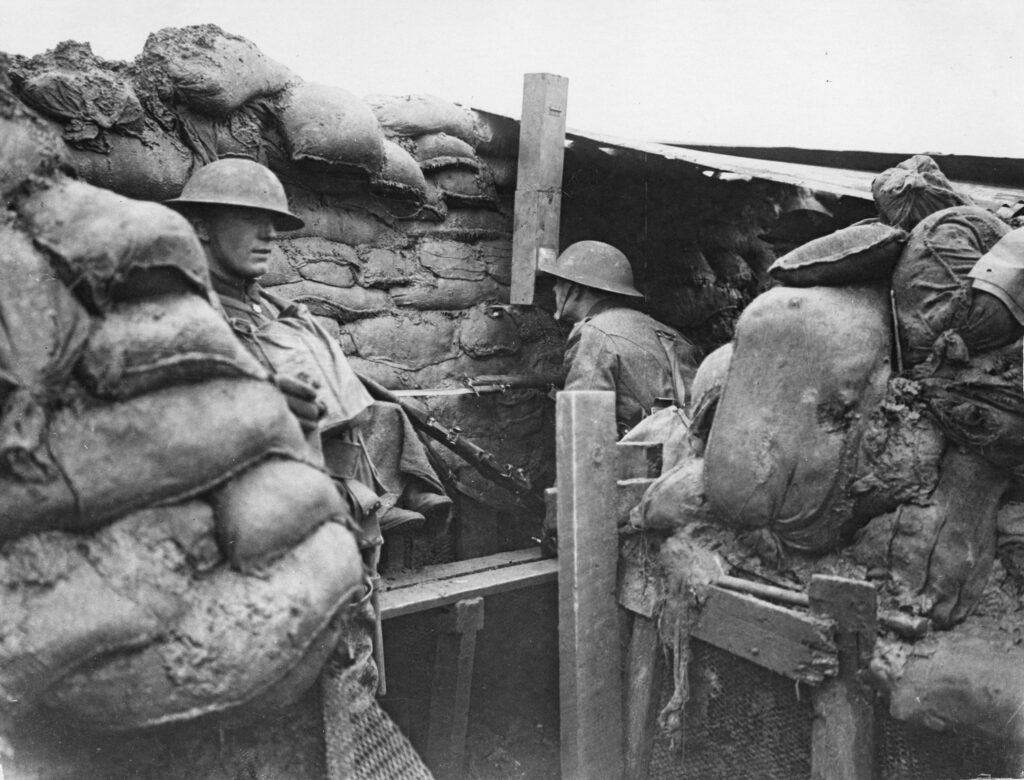
The front line — the fire trench — was where soldiers faced the enemy directly. It was typically about two metres deep and wide enough for two men to pass each other. The forward wall — the parapet — was built up with sandbags to provide cover and a firing step from which soldiers could look over and fire their rifles.
The fire trench did not run in a straight line. It zigzagged in a pattern of short straight sections connected at angles — called traverses. This design had a crucial purpose. If an enemy soldier entered the trench, he could only fire along one short section at a time, not down the entire length. It also limited the damage from shell bursts — a shell exploding in one bay of a zigzag trench would not send lethal shrapnel flying the full length of the position.
Support and Reserve Trenches
Behind the fire trench were two more parallel lines — the support trench and the reserve trench. The support trench held troops ready to reinforce the fire trench if it came under attack. The reserve trench provided a fallback position and housed headquarters, supply stores, and field kitchens.
These three lines were connected by communication trenches — long passages running perpendicular to the main lines, along which troops, supplies, ammunition, food, and casualties could move under cover. In a well-developed section of the Western Front, a soldier could walk from the reserve trench all the way to the fire trench without once exposing himself to direct enemy fire.
Dugouts
Cut into the walls of the trenches — or deeper, straight down into the ground — were dugouts. These varied enormously in quality and depth depending on who had built them and how long they had been there.
British dugouts were typically shallow affairs — a few steps down from the trench floor, offering protection from weather and shell fragments but not from a direct hit. German dugouts, by contrast, were often engineering marvels. Having decided early in the war that they would hold their current positions indefinitely, the Germans invested heavily in deep, permanent shelters. Some went down nine metres into the bedrock — deep enough to shelter men safely from even the heaviest artillery bombardment.
This difference in dugout quality would have catastrophic consequences on July 1, 1916 — the first day of the Battle of the Somme — when a week-long British bombardment failed to kill the German soldiers sheltering far below, who emerged intact to man their machine guns as the British infantry advanced.
No Man’s Land
Between the opposing front lines lay No Man’s Land — the strip of ground that belonged to neither side and that crossing meant almost certain death during daylight hours.
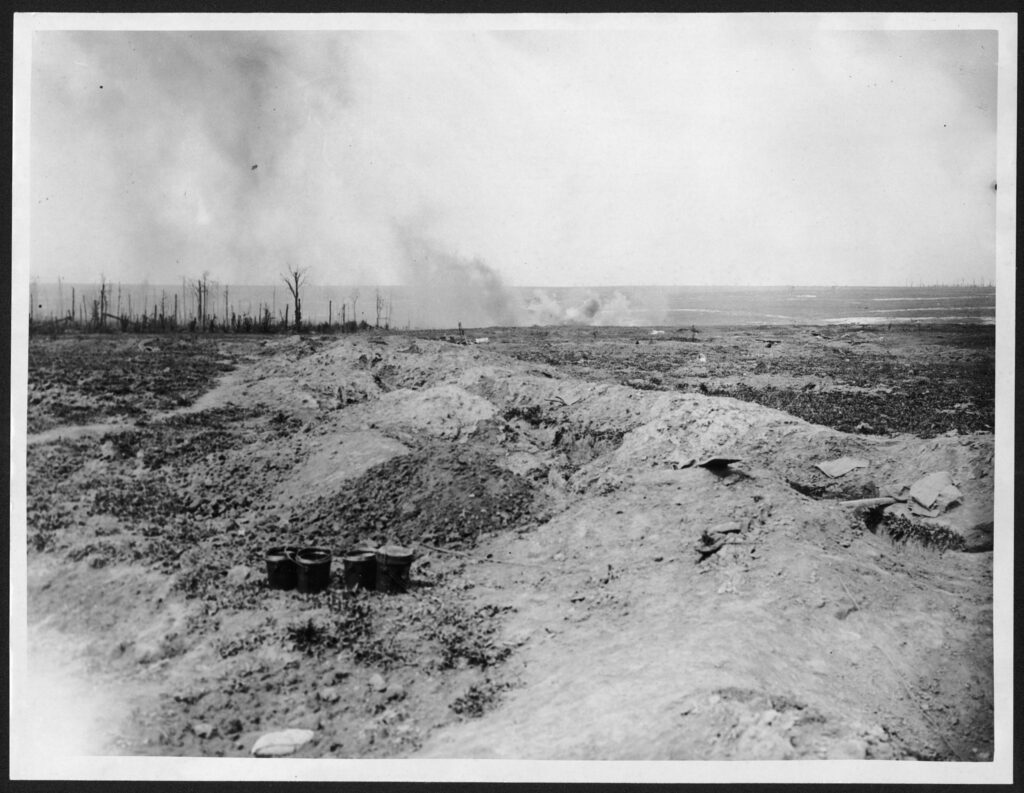
No Man’s Land varied in width from as little as 25 metres in some sectors to several hundred metres in others. It was not empty ground. It was a devastated landscape of shell craters, tangles of rusting barbed wire, the ruins of farms and villages that had existed before the war, and the unburied bodies of soldiers from both sides who had died attempting to cross it.
At night, No Man’s Land became a dangerous working environment. Wiring parties went out to repair or extend barbed wire defences. Patrols crept through the shell craters gathering intelligence about enemy positions. Raiding parties crossed to attack enemy trenches, take prisoners, and return with information. These night operations required extraordinary courage — moving silently through complete darkness, knowing that a flare could illuminate everything at any moment, knowing that the enemy was doing the same thing somewhere nearby.
Why Trench Warfare Was So Hard to Break
The fundamental tactical problem of World War 1 — the problem that cost millions of lives and that neither side managed to solve for most of the war — was how to break through a well-defended trench system.
It sounds like it should have been straightforward. The trenches were, after all, just ditches. Men had been breaking through defensive positions for thousands of years. Why was this so different?
The answer comes down to the combination of three technologies that made the defence almost impregnable.
Why Was Trench Warfare Used?
- Defensive weapons (machine guns, artillery) were stronger than offensive tactics
- Both sides needed protection from constant fire
- Digging in was the fastest way to survive
- Once trenches formed, neither side could easily break through
The Machine Gun
A single machine gun, properly positioned and served by a two-man crew, could fire 400 to 600 rounds per minute. It could sweep a field of fire 180 degrees wide. It did not require remarkable aim — against a dense line of advancing infantry, it simply needed to fire in the right general direction.
The typical WWI attack involved infantry advancing across open ground toward enemy trenches. Even if artillery had suppressed most of the enemy positions, one or two surviving machine gun nests could kill hundreds of men in minutes. On July 1, 1916, British troops advancing toward German positions at the Somme were cut down so rapidly that some battalions lost over half their men in the first twenty minutes.
Barbed Wire
Barbed wire seems primitive compared to machine guns and artillery. In the context of trench warfare, it was a weapon of mass destruction.
Dense belts of barbed wire, sometimes twenty or thirty metres deep, were laid in front of trench positions. An infantryman trying to cut through or climb over barbed wire under fire was essentially standing still in the open while being shot at. The wire was supposed to be cut by artillery bombardment before attacks — but this rarely worked as well as planned. The wire often survived heavy shelling intact, or tangled into worse configurations that were even harder to cross.
At the Somme, men were found dead hanging on barbed wire they had been unable to cross, killed while trying to find a gap. It was one of the defining images of the war’s particular horror.
Artillery — Shield and Sword
Artillery was both the primary killer of trench warfare and the primary means of trying to break through. The deep rumbling of guns was the constant soundtrack of life on the Western Front — never entirely absent, rising to a deafening roar during major offensives.
Artillery was used in two ways. Defensive artillery — positioned behind the lines — fired on attacking infantry crossing No Man’s Land and on enemy rear areas, supply lines, and troop concentrations. Offensive artillery was used in prolonged bombardments before attacks, intended to cut wire, destroy enemy positions, and kill or daze enemy soldiers in their dugouts.
The problem with offensive artillery bombardment was the one that took years to solve. Once a bombardment began, the enemy knew an attack was coming — the element of surprise was gone. The bombardment destroyed the ground across which the attacking infantry then had to advance, turning it into a cratered moonscape that slowed movement to a crawl. And as the Somme demonstrated catastrophically, deep dugouts could protect defenders from even the heaviest bombardment, leaving machine guns intact to cut down the attackers.
Daily Life Inside the System
Understanding what trench warfare was means understanding not just the physical structure but the human experience of living inside it.
The routine of the trenches was relentless and exhausting. Soldiers typically rotated through the front line trench, the support trench, and periods of rest behind the lines — though “rest” rarely meant what the word implies. Time in the front trench might last four to eight days, followed by an equivalent period in the support trench, followed by a few days further back.
Stand To — the requirement for every soldier to be at his post, rifle ready, at dawn and dusk — structured each day. These were the hours most likely to see an enemy attack, and missing Stand To was a serious disciplinary offence. Between Stand Tos came the endless maintenance work — repairing collapsed walls, draining flooded sections, replacing rotting duckboards, filling sandbags.
The constant physical misery of the trenches — the mud, the rats, the lice, the smell, the noise of the guns — has been documented in thousands of letters, diaries, and memoirs. What comes through most consistently is not the dramatic moments of combat but the grinding, wearing quality of ordinary days — the boredom punctuated by terror, the cold and the wet and the hunger, the difficulty of sleeping in a place where sleep was dangerous.
The Attempts to Break the Stalemate
Neither side accepted the stalemate of trench warfare passively. Both sides spent four years experimenting with ways to break through — some conventional, some extraordinarily innovative.
Artillery and the Creeping Barrage
The most obvious solution was more artillery — longer, heavier bombardments that would genuinely destroy enemy positions before an infantry attack. Over the course of the war, British artillery technique improved enormously. The creeping barrage — in which a curtain of artillery fire moved forward at a set pace just ahead of the advancing infantry — was refined into a genuine tactical tool by 1917 and 1918. Counter-battery fire — using sound ranging and aerial observation to locate and destroy enemy guns — became increasingly effective.
Mining
One of the most dramatic attempts to break trench warfare was underground. Both sides dug tunnels under No Man’s Land — sometimes extending for hundreds of metres — packed the ends with explosives, and detonated them at the moment of an attack.
The largest mining operation of the war came at the Battle of Messines in June 1917, when British engineers detonated 19 enormous mines under the German lines simultaneously. The explosion was heard in London. It killed approximately 10,000 German soldiers instantly and created craters that are still visible in the Belgian landscape today. The attack that followed was one of the most successful of the entire war.
Poison Gas
Germany introduced poison gas at the Second Battle of Ypres in April 1915 — the first large-scale use of chemical weapons in warfare. Clouds of chlorine gas drifted toward the Allied lines, causing mass panic and casualties among soldiers who had no protection against it.
Gas seemed initially like it might be the breakthrough weapon the war needed. In practice, it proved less decisive than it appeared. Both sides quickly developed gas masks that provided reasonable protection. Wind and weather made gas attacks unpredictable — the gas could drift back toward the attackers. And as with every other offensive weapon of trench warfare, the defence adapted faster than the offence could exploit.
The Tank
The weapon that came closest to genuinely solving the problem of trench warfare was the tank — first used by the British at the Battle of Flers-Courcelette in September 1916.
The tank could cross barbed wire, resist machine gun fire, and advance across shell-cratered ground that would stop infantry. It terrified German soldiers who encountered it for the first time. At the Battle of Cambrai in November 1917, a mass attack of 476 tanks achieved a breakthrough that surpassed anything accomplished in months of conventional fighting — advancing further in hours than the Somme offensive had managed in months.
The full potential of the tank was not realized until 1918 — and even then, the tanks of WWI were slow, mechanically unreliable, and vulnerable to artillery fire. But the principle had been established. Combined arms warfare — tanks, artillery, aircraft, and infantry working together in coordination — was the answer to trench warfare. It was just figured out too late to save most of the men who died in the years before it was perfected.
The Eastern Front — Trench Warfare Was Not Universal
It is worth noting that trench warfare was primarily a feature of the Western Front. The war was not the same everywhere.
On the Eastern Front — stretching from the Baltic Sea to the Black Sea — the distances were so vast that the kind of continuous trench line that developed in the West was never established. The Eastern Front was more fluid, with large advances and retreats, encirclements and breakthroughs. It was still brutally costly — Russia lost perhaps 1.7 million soldiers — but it looked and felt different from the static mud of Flanders.
The Italian Front, where Italy fought Austria-Hungary along the Isonzo River, developed its own particular form of the stalemate — eleven separate battles along the same river valley over two years, each one consuming enormous numbers of men for minimal territorial gain.
The Middle Eastern campaigns — Gallipoli, Mesopotamia, Palestine — had elements of both mobile warfare and static siege. Lawrence of Arabia’s campaign in the Arabian Peninsula was almost entirely guerrilla warfare with no trenches at all.
Trench warfare was the Western Front’s particular nightmare. But the Western Front was where the war was decided.
The Legacy — How Trench Warfare Changed Everything
The experience of trench warfare left marks on military thinking, on literature, on culture, and on the psychology of entire nations that lasted for generations.
Militarily, the lessons of trench warfare drove the development of the weapons and tactics that would define 20th-century warfare — tanks, aircraft, combined arms operations, radio communication, and eventually the blitzkrieg tactics that Germany used to overturn the Western Front stalemate in World War 2 in just six weeks.
Culturally, trench warfare produced some of the greatest war literature in the English language. Wilfred Owen, Siegfried Sassoon, Robert Graves, and Erich Maria Remarque all wrote from direct experience of the trenches. Their work — poems, memoirs, novels — shaped how an entire century understood war. Owen’s “Dulce et Decorum Est,” with its description of a gas attack in the trenches, remains the most famous anti-war poem in the English language. All Quiet on the Western Front, Remarque’s novel of the German trench experience, sold millions of copies and was burned by the Nazis for its honest depiction of what the war had actually been.
Politically, the memory of trench warfare created in Britain and France a deep, instinctive horror of another European war — a horror so powerful that it contributed directly to the appeasement policies of the 1930s, when both governments convinced themselves that almost any compromise with Hitler was better than another four years of mud and machine guns.
They were wrong about appeasement. But they were not wrong about the trenches.
What aspect of trench warfare surprised you most — the physical conditions, the tactical problems, or the sheer scale of the system? Leave your thoughts in the comments. And if you want to understand what daily life inside the trenches was actually like for the men who lived there, the full story of life in the trenches goes deeper into the human experience of this extraordinary system.
One response to “What Was Trench Warfare? The System That Defined World War 1”
-
[…] Many soldiers on the Western Front spent the majority of those four years rotating through the same system of trenches — the same mud, the same rats, the same routine of stand to at dawn and stand down at dusk, the […]
Leave a Reply