World War 1 Weapons — Technology That Changed Warfare Forever
In August 1914, cavalry officers rode to war on horseback, carrying swords.
In November 1918, the war ended with tanks rolling across the battlefield, aircraft dropping bombs from the sky, poison gas drifting on the wind, and artillery shells falling from distances of more than twenty kilometres.
In four years, warfare had been transformed more completely than in the previous four centuries. The weapons that armies took into the field in 1914 were recognizable descendants of weapons that had existed for hundreds of years — rifles, artillery, cavalry. The weapons that ended the war in 1918 were the direct ancestors of everything that has been used in every conflict since.
World War 1 was the crucible in which modern warfare was forged. Understanding the weapons of World War 1 means understanding not just how the Great War was fought, but why every subsequent war has looked the way it does.
This is the complete guide to the weapons that changed everything.
What Weapons Were Used in World War 1?
World War 1 weapons included rifles, machine guns, artillery, poison gas, tanks, aircraft, submarines, and a range of smaller weapons such as grenades and mortars. These technologies transformed warfare from mobile battles into a destructive, industrial conflict dominated by firepower and defensive positions.
The Rifle — The Soldier’s Constant Companion
Every soldier on every front carried a rifle. It was the most personal of all World War 1 weapons — the one a soldier cleaned, maintained, slept beside, and depended on for his life every single day.
The rifles of World War 1 were bolt-action weapons — after each shot, the soldier had to manually operate a bolt mechanism to eject the spent cartridge and chamber a fresh round. This limited the rate of fire to perhaps fifteen aimed shots per minute for a trained soldier — fast by the standards of previous wars, but agonizingly slow compared to the machine guns that dominated the battlefield.
The standard British rifle was the Lee-Enfield — arguably the finest bolt-action military rifle ever produced. British soldiers were trained to fire fifteen aimed rounds per minute using a technique called the Mad Minute, and at the Battle of Mons in August 1914, German soldiers advancing against British positions reported coming under what they believed was machine gun fire. It was not. It was well-trained British infantrymen with Lee-Enfields firing so rapidly and accurately that the rate of fire was indistinguishable from automatic weapons.
The Germans used the Mauser Gewehr 98 — a slightly less rapid but extremely accurate rifle that remained in service in various forms through World War 2 and beyond. The French had the Lebel Model 1886 — older and somewhat less practical than either the Lee-Enfield or the Mauser, but still effective in trained hands.
The rifle remained the standard infantry weapon throughout the war. But it was rapidly overshadowed by weapons that could kill far more efficiently, far more impersonally, and at far greater distances.
The Machine Gun — The Weapon That Created the Trenches
If any single weapon defined World War 1, it was the machine gun.
The machine gun was not a new invention in 1914. Hiram Maxim had developed the first fully automatic machine gun in 1884 — a weapon that used the energy of its own recoil to eject spent cartridges and chamber new rounds automatically, allowing continuous fire as long as ammunition was fed into it. By 1914, every major army had adopted machine guns in significant numbers.
What nobody had fully anticipated was what the machine gun would do to the tactics of the battlefield.
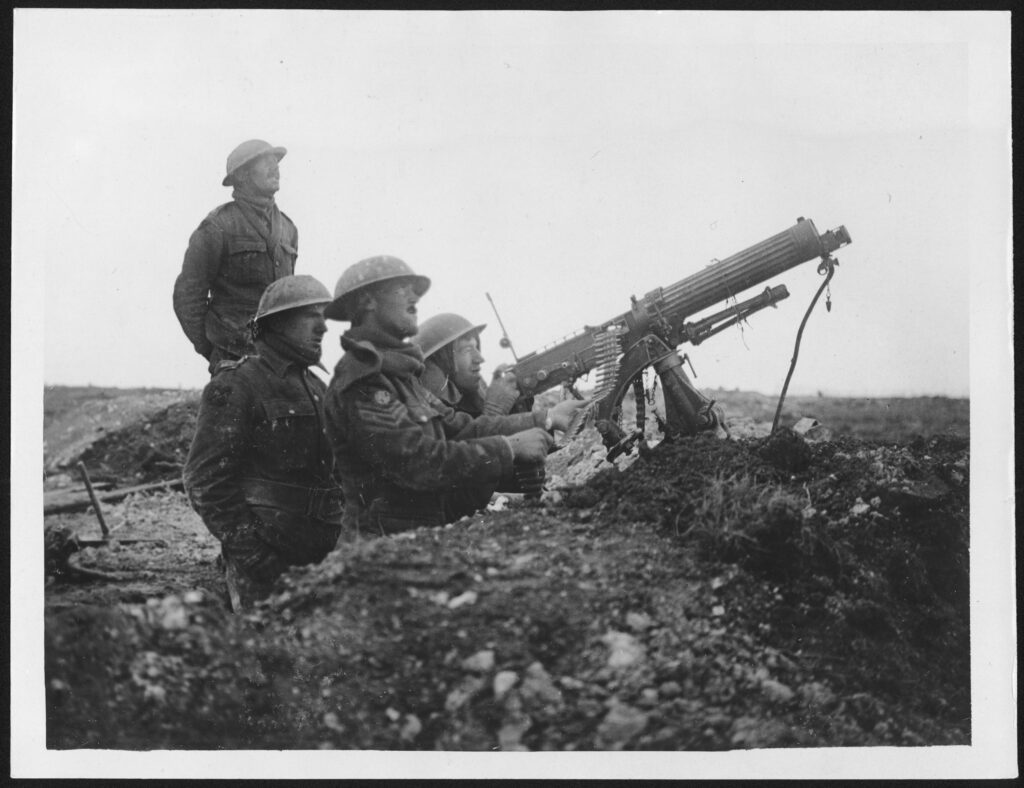
A single Vickers machine gun — the standard British heavy machine gun — could fire 450 to 600 rounds per minute. It was water-cooled, which meant it could maintain this rate of fire for extended periods without overheating. With a trained crew of two men feeding ammunition belts and operating the weapon, a single Vickers could sweep a field of fire 180 degrees wide, making it essentially impossible for infantry to advance across open ground within its range.
The German equivalent — the MG08, based on the original Maxim design — was similarly devastating. At the Somme on July 1, 1916, German MG08 crews emerged from their deep dugouts after seven days of British bombardment and found long lines of British infantry walking toward them. In some sectors, entire battalions were cut down in minutes. The machine gun did not need to be aimed carefully — against a dense line of advancing infantry, it simply needed to fire in the right general direction.
The tactical consequence was the Western Front itself. The machine gun made frontal assault across open ground so costly that neither side could advance. Both sides dug trenches. Both sides put machine guns in fortified positions covering every approach. And four years of attempts to break through this system — at the Somme, at Verdun, at Passchendaele — demonstrated just how thoroughly the machine gun had made the offensive the weaker option.
The lighter machine guns developed during the war — the British Lewis gun and the German MG08/15 — could be carried and operated by a single soldier, bringing automatic fire power down to the infantry section level. By 1918, a British infantry section of ten men typically carried a Lewis gun, giving even the smallest tactical unit a weapon capable of suppressing enemy movement over a wide area.
The machine gun did not just change how the war was fought. It changed the fundamental relationship between attack and defence in warfare — a relationship that still shapes military thinking today.
Artillery — The Great Killer
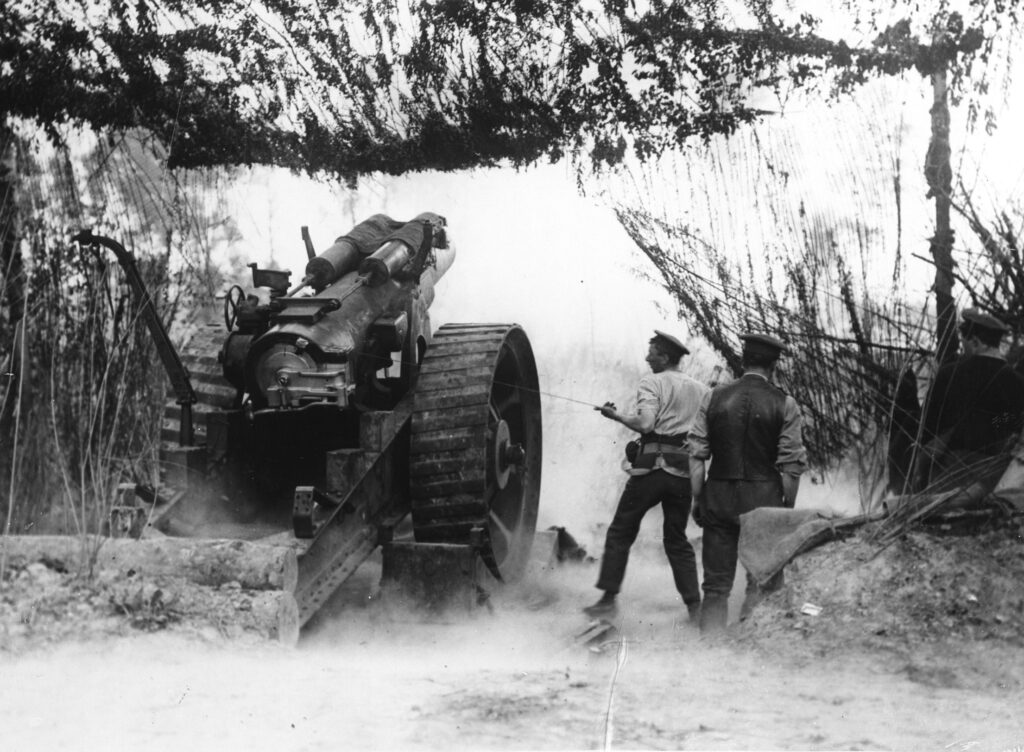
Artillery was the dominant weapon of World War 1 by almost every measure. Approximately 60 percent of all casualties on all fronts were caused by artillery shells. More men died from artillery than from machine guns, rifles, gas, and all other causes combined.
The artillery of 1914 ranged from light field guns — mobile weapons that could keep pace with advancing infantry — to enormous siege howitzers that could hurl shells weighing hundreds of kilograms over distances of twenty kilometres or more.
The British 18-pounder field gun was the workhorse of the Royal Artillery — a mobile, reliable weapon that fired a shell weighing approximately 8 kilograms. The French 75mm field gun — the famous Soixante-Quinze — was perhaps the finest field artillery piece of the war, capable of firing fifteen to thirty rounds per minute with a well-trained crew and accurate to extreme ranges. The Germans had their own excellent range of field artillery, supplemented by the heavy howitzers that had been specifically designed and built for the anticipated siege warfare of the opening campaign.
The largest artillery pieces of the war were almost incomprehensible in scale. The German Paris Gun — used to bombard the French capital from a distance of over 120 kilometres in 1918 — was so large that it required a specially built railway to transport it and a crew of eighty men to operate it. Its shells took three minutes to reach their targets, rising so high into the atmosphere that their trajectory had to be calculated with corrections for the rotation of the Earth.
The use of artillery evolved dramatically over four years of war. In 1914, artillery was used primarily in direct fire mode — aimed at visible targets. By 1916, indirect fire — artillery firing at targets it could not see, guided by maps, aerial observation, and mathematical calculations — had become standard. The creeping barrage — a curtain of shellfire that moved forward at a set pace just ahead of attacking infantry — was refined into an effective tactical tool. Counter-battery fire — using sound ranging and aerial photography to locate enemy artillery and destroy it — became increasingly sophisticated.
The most significant artillery innovation of the war was the development of predicted fire — the ability to calculate firing data so precisely that guns could hit targets accurately without prior registration shots that would warn the enemy an attack was coming. This technique, combined with the improved coordination of artillery and infantry, was central to the tactical successes of 1917 and 1918 that finally broke the stalemate.
Poison Gas — The Weapon Everyone Feared
Of all the World War 1 weapons, none produced more terror — or more lasting moral revulsion — than poison gas.
Germany introduced large-scale chemical warfare at the Second Battle of Ypres on April 22, 1915. At 5:00 in the afternoon, German troops opened 5,730 cylinders containing 168 tonnes of chlorine gas along a four-kilometre section of the front. The yellowish-green cloud drifted toward the Allied lines on the evening breeze. French and Algerian troops, who had no protection against it and had never seen anything like it, broke and ran. A four-kilometre gap opened in the Allied line.
Germany had achieved a breakthrough — and then failed to exploit it, partly because even German commanders had not fully anticipated how effective the gas would be and had not prepared sufficient reserves to advance through the gap.
Chlorine gas worked by destroying lung tissue, causing victims to drown in their own fluid. Death could take up to forty-eight hours. The symptoms — coughing, choking, burning eyes, the sensation of drowning while standing upright — were horrifying.
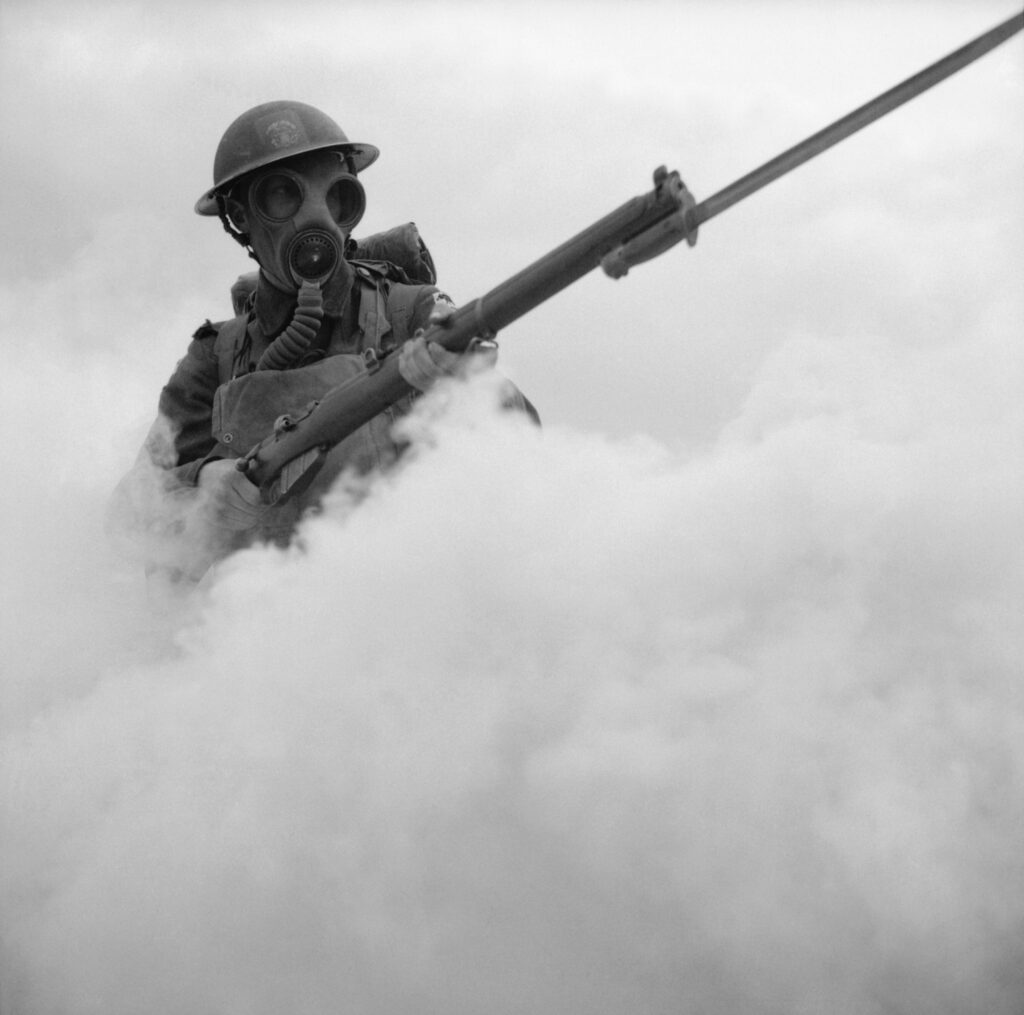
Allied forces responded rapidly. Within weeks, improvised gas masks — initially just pads of wet cloth or chemical-soaked material held over the face — were being issued. Within months, proper box respirators that filtered both chlorine and the phosgene gas that Germany introduced next were standard equipment. By 1916, a trained soldier could don a gas mask in under six seconds.
Germany introduced a more insidious weapon in July 1917 — mustard gas, or dichlorodiethyl sulphide. Unlike the earlier gases, mustard gas was not primarily designed to kill. It was designed to incapacitate. A blistering agent, it caused severe chemical burns to any skin it contacted — eyes, throat, lungs, and any exposed skin. It could penetrate clothing. It contaminated the ground and equipment for days. A soldier who walked through a mustard gas area and survived might be blind for weeks, covered in chemical burns, and unable to fight. More importantly, he required extensive medical care — taking doctors, nurses, and hospital capacity away from other casualties.
Mustard gas caused approximately 80 to 90 percent of all chemical warfare casualties of the war, but only around 2 to 3 percent of deaths. It was the most effective area-denial weapon of the conflict.
By the end of the war, both sides had used gas extensively. Approximately 1.3 million gas casualties were recorded, of whom approximately 90,000 died. The psychological impact was out of proportion even to these significant numbers — the fear of gas, the requirement to wear uncomfortable and vision-limiting masks during attacks, and the contamination of the battlefield all significantly affected how the war was fought.
The legacy of chemical warfare in World War 1 was the Geneva Protocol of 1925, which banned the use of chemical and biological weapons in warfare. It remains one of the most widely observed arms control agreements in history — a direct response to what the world had seen between 1915 and 1918.

The Tank — The Weapon That Broke the Stalemate
The tank was the most revolutionary weapon to emerge from World War 1 — and the one whose influence on subsequent warfare has been greatest.
It was developed specifically to solve the tactical problem that had created the stalemate — how to advance across ground swept by machine gun fire and protected by barbed wire. The solution, proposed by British military engineers and enthusiastically championed by Winston Churchill as First Lord of the Admiralty, was an armoured vehicle that could crush barbed wire under its tracks, resist machine gun fire with its steel hull, and cross the shell craters and trenches of No Man’s Land that stopped ordinary vehicles.
The first tanks — the British Mark I — were extraordinary-looking machines. Rhomboid in shape, with tracks running around their entire perimeter to help them cross trenches, they were armed with naval guns or machine guns in sponsons — armoured protrusions on each side. Inside, they were a nightmare of heat, noise, fumes, and cramped conditions. The crew of eight men operated in temperatures that could reach 50 degrees Celsius, with no proper ventilation, surrounded by the deafening noise of the engine and the clang of bullets hitting the hull.
The Mark I tanks went into action for the first time on September 15, 1916, during the Battle of Flers-Courcelette on the Somme. Of the 49 tanks committed to the attack, only 21 reached their starting positions — the others had broken down on the approach march, victims of their own mechanical unreliability. But the ones that did advance achieved results that astonished observers on both sides. German soldiers, encountering these armoured, fire-breathing machines for the first time, frequently panicked and ran. A single tank advancing down a village street could clear defenders who would have taken hours and hundreds of casualties to shift by conventional means.
The full potential of the tank was demonstrated at the Battle of Cambrai on November 20, 1917, when 476 British tanks attacked on a front of nearly ten kilometres without the customary prolonged artillery bombardment — preserving the element of surprise. In one day, the tanks achieved an advance of eight kilometres — more than the entire Battle of Passchendaele had managed in three and a half months. Church bells rang in London for the first time during the war to celebrate the news.
The gains were largely lost to a German counterattack ten days later. But the principle had been established. The tank, used in mass and coordinated with infantry, artillery, and aircraft, could break through even a well-prepared defensive position.
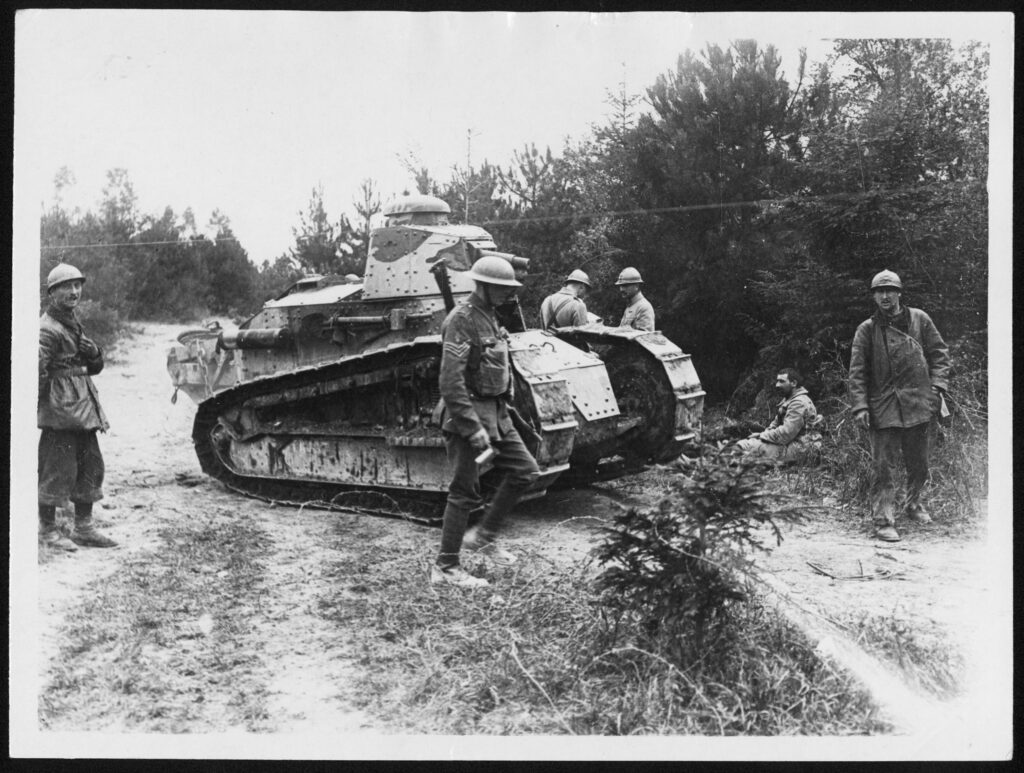
By 1918, the British had over 2,500 tanks. The French had developed their own designs — the light Renault FT, which introduced the rotating turret that became the standard for virtually every tank designed since. Germany, slower to recognize the weapon’s potential, had only produced approximately 20 of their A7V tanks by the war’s end — a number that reflected both industrial constraints and a failure of vision that would be dramatically corrected in the next war.
Aircraft — The Birth of Air Power
In 1914, military aviation barely existed. By 1918, it had become a central element of warfare — with dedicated fighter aircraft, bombers, ground attack planes, and reconnaissance aircraft all performing specialized roles that had been defined and refined through four years of combat.
The war began with aircraft used almost exclusively for reconnaissance — flying over enemy positions and reporting what they saw. The value of aerial observation was immediately apparent. Aircraft could see over hills and behind fortifications that ground observers could not. They could photograph enemy positions in detail. They could observe artillery fire and radio corrections to the guns below.
Both sides quickly recognized that the other side’s reconnaissance aircraft needed to be stopped — and that this required aircraft specifically designed to shoot them down. The fighter aircraft was born.
The early development of air combat was improvised and experimental. Pilots initially fired pistols at each other from their cockpits. Then observers carried machine guns. Then the challenge was to fire a machine gun forward through the propeller arc without shooting off the propeller — a problem solved by the Dutch designer Anthony Fokker, working for Germany, who developed an interrupter gear that synchronized the machine gun to fire only when a propeller blade was not in the line of fire.
The Fokker Eindecker, equipped with this synchronized machine gun, dominated the skies over the Western Front in late 1915 and early 1916 in a period known as the Fokker Scourge — Allied aircraft were shot down in such numbers that British pilots called themselves “Fokker Fodder.” The Allies responded with better designs — the Nieuport 11 and the DH2 — and the technological leapfrog that would define air combat for the rest of the century had begun.
The great aces of World War 1 — Manfred von Richthofen, the Red Baron, with 80 confirmed victories; René Fonck of France with 75; Britain’s Edward Mannock with 61 — became the first air combat heroes, celebrated in their own time with a fervour that reflected how new and dramatic their form of warfare seemed.
But individual heroics aside, the real story of World War 1 aviation was institutional. By 1918, the British Royal Air Force — formed on April 1, 1918, as the world’s first independent air force — had 22,000 aircraft and 290,000 personnel. Strategic bombing — the use of aircraft to attack targets behind enemy lines, including cities and industrial facilities — had been attempted by both sides, foreshadowing the devastating bomber campaigns of World War 2.
The aircraft of 1918 — capable of speeds over 200 kilometres per hour, armed with synchronized machine guns, capable of carrying significant bomb loads — were almost unrecognizable compared to the fragile reconnaissance machines of 1914. In four years, aviation had gone from an experimental novelty to a central element of military power.
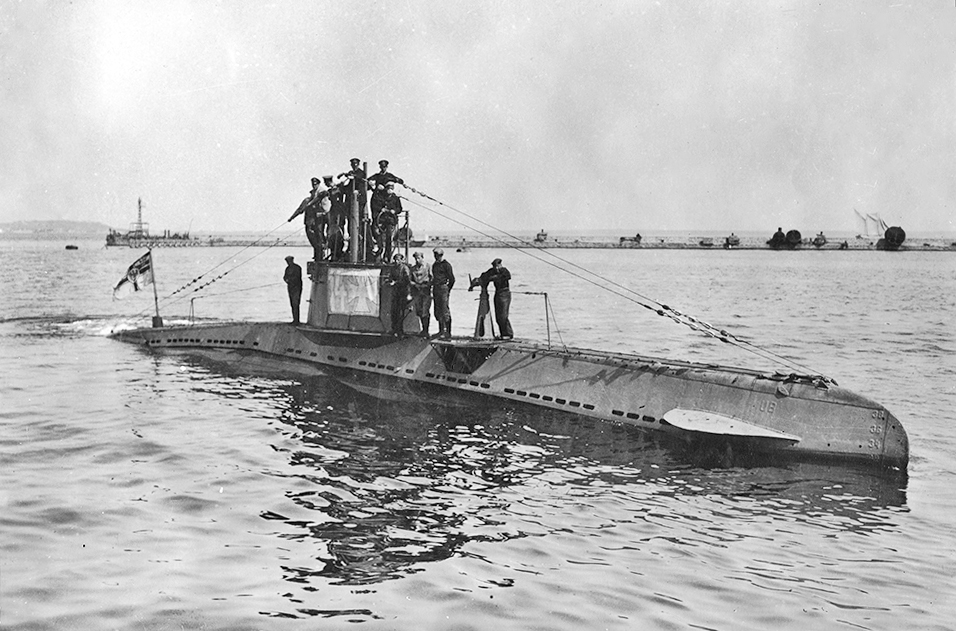
Submarines — The War Beneath the Waves
The submarine was not invented during World War 1 — but the war transformed it from an experimental curiosity into a weapon of strategic importance.
Germany’s U-boat fleet — Unterseeboote, literally “undersea boats” — became the primary instrument of Germany’s attempt to strangle Britain’s supply lines. Britain, as an island nation, imported the majority of its food and raw materials by sea. If the U-boats could sink enough ships, Britain would be starved into submission.
The German submarine campaign went through several phases. Unrestricted submarine warfare — sinking any ship in a defined war zone without warning — was introduced in February 1915, then suspended after the sinking of the Lusitania in May 1915 caused international outrage. It was resumed in February 1917 as Germany’s last strategic gamble — and it nearly worked. In April 1917, German U-boats were sinking ships faster than they could be replaced. Britain had perhaps six weeks of food supplies remaining.
The crisis was met by the convoy system — grouping merchant ships together and protecting them with naval escorts. The convoy system reduced losses dramatically. Combined with the introduction of depth charges, improved sonar technology, and the use of aircraft for submarine detection, it turned the tide of the U-boat campaign. By late 1917, U-boat losses were rising and the threat had been contained — though never eliminated.
Germany built approximately 360 U-boats during the war and lost 178 of them. They sank approximately 5,000 Allied ships — including the Lusitania with 1,198 dead — and killed approximately 15,000 Allied sailors. The submarine campaign also played a direct role in bringing the United States into the war, when the resumption of unrestricted submarine warfare in February 1917 was one of the primary triggers for the American declaration of war in April.
The Flame Thrower, the Mortar, and the Grenade
Beyond the major weapons systems, World War 1 produced a generation of smaller weapons that shaped the close-quarters fighting of trench warfare.
The flame thrower — Flammenwerfer in German — was first used by German forces in 1915. It projected a stream of burning oil up to forty metres, clearing trenches and dugouts in a way that neither grenades nor rifles could match. It was terrifying in its immediate effect but had significant limitations — the operators were obvious targets and the fuel supply was limited. It remained a specialist weapon used in specific assault operations rather than a general infantry tool.
The trench mortar filled a crucial gap in the weapons available to front-line troops — a weapon that could loft a bomb over a short distance and drop it almost vertically into enemy trenches. Standard artillery guns fired on flat trajectories and could not hit targets in deep trenches. The mortar’s steep angle of fire allowed it to do exactly this. Both sides developed mortars of various sizes during the war, and by 1918 the mortar had become a standard component of infantry fire support.
The hand grenade — ancient in concept, modernized for industrial war — became essential to trench fighting. Soldiers raiding enemy trenches needed a weapon they could throw around corners and into dugouts without exposing themselves. The British Mills bomb, the German stick grenade — the Stielhandgranate or “potato masher” — and dozens of improvised variants were used in enormous quantities. British forces alone threw approximately 75 million grenades during the war.
The Legacy — How WWI Weapons Shaped the Modern World
The weapons of World War 1 did not disappear when the war ended. They transformed warfare permanently.
The tank, developed in desperation to break the stalemate of the Western Front, became the central weapon of 20th century land warfare. German panzer divisions using massed tanks and combined arms tactics swept through France in six weeks in 1940 — doing in days what four years of Western Front fighting had failed to accomplish. The principles of armoured warfare first worked out between 1916 and 1918 still define how armies fight today.
The aircraft of 1918 were the direct ancestors of the fighters and bombers of World War 2. The independent air force concept, established by Britain in 1918, became the model for every major power. Strategic bombing — tested experimentally in WWI — was developed into a primary instrument of war by 1939 to 1945.
The submarine campaign of World War 1 established the importance of naval interdiction and the vulnerability of island nations to trade warfare. The Battle of the Atlantic in World War 2 was a direct continuation of the same strategic struggle, fought with more sophisticated weapons on both sides.
The machine gun, the mortar, the grenade, the gas mask — all of these became standard components of the military toolkit that has been used in every conflict since. Even the tactical lessons of World War 1 — about combined arms, about the relationship between firepower and maneuver, about the importance of logistics and supply — remain central to military thinking in the 21st century.
The weapons of World War 1 were forged in the worst possible laboratory — four years of industrial-scale killing in the mud of the Western Front. The lessons they taught were written in the deaths of seventeen to twenty million people.
They changed warfare forever. The world they helped create is still the world we live in.
Which World War 1 weapon do you think had the greatest impact on how warfare developed — the tank, the aircraft, or the machine gun? Leave your thoughts in the comments. And if you want to understand how these weapons were actually used in practice, the full story of the Western Front brings the technology to life on the battlefield where it mattered most.
Leave a Reply