The Western Front Explained — The Main Battlefield of World War 1
What Was the Western Front?
The Western Front was the main battlefield of World War 1, stretching approximately 700 kilometres from the North Sea in Belgium to the Swiss border. It was defined by trench warfare, static front lines, and some of the deadliest battles in human history between 1914 and 1918.
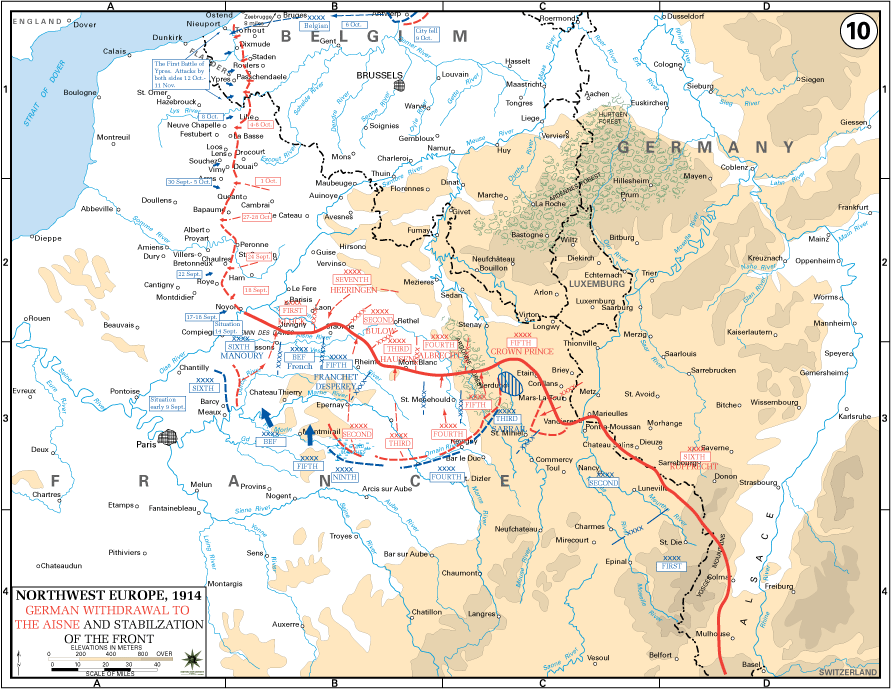
Draw a line from the Belgian coast at Nieuport, south through the cities of Ypres, Arras, and Amiens, past the valley of the Somme, through Verdun and the hills of Alsace, all the way to the Swiss border at Basel.
That line — approximately 700 kilometres long — was the Western Front.
For four years, from the autumn of 1914 to November 1918, that line barely moved. Millions of men lived in the mud on either side of it. Millions of shells fell along it. Millions of soldiers died trying to push it a few kilometres in one direction or another. The villages and towns that had existed along it before the war were obliterated so completely that some of them were never rebuilt.
The Western Front was not just a battlefield. It was the central fact of World War 1 — the place where the war was decided, where most of the dying happened, and where the experience that defined an entire generation was forged in mud and fire and noise that never entirely stopped.
This is the complete story of the Western Front — how it formed, how it was fought, and why it has never been forgotten.
How the Western Front Formed — The Opening Weeks of 1914
The Western Front did not exist at the start of the war. In August 1914, both sides expected and planned for a war of rapid movement — sweeping advances, decisive battles, quick conclusions.
Germany’s opening strategy — the Schlieffen Plan — called for a massive sweep through neutral Belgium and northern France to knock out France within six weeks before turning east to deal with Russia. The plan required speed above everything else. Germany could not afford to fight a prolonged two-front war simultaneously.
For the first weeks, the plan seemed to be working. German forces moved through Belgium with terrifying speed, brushing aside the small Belgian army and overwhelming a British Expeditionary Force that had arrived to help. By early September 1914, German troops were within 40 kilometres of Paris. The French government evacuated to Bordeaux. It appeared France might fall before the month was out.
Then came the Battle of the Marne.
Between September 5 and 12, 1914, French and British forces launched a counterattack against the advancing German armies along the Marne River east of Paris. The German advance was stopped — partly through effective Allied tactics, partly through a gap that opened between two German armies that Allied forces exploited, and partly because the German supply lines, stretched to their absolute limit by the speed of the advance, had simply broken down.
The German armies retreated north and dug in on high ground. The Allied forces pursued and dug in opposite them. Both sides then tried to outflank each other by extending their lines northward — the Race to the Sea, historians would call it — each side attempting to get around the open northern end of the enemy’s position and attack from the side.
By November 1914, both sides had run out of room to maneuver. The lines had extended all the way to the English Channel in the north and the Swiss border in the south. There were no more open flanks to turn. The Western Front had been born.
The Geography — Why the Western Front Was Where It Was
The Western Front did not follow natural geographical features like rivers or mountain ranges in the way that borders often do. It followed the accident of where the armies happened to stop in the autumn of 1914 — where the German advance had been halted, where the Allied counterattack had run out of momentum, where each side had dug in and decided this was where it would stand.
This accident of geography had profound consequences for how the war was fought.
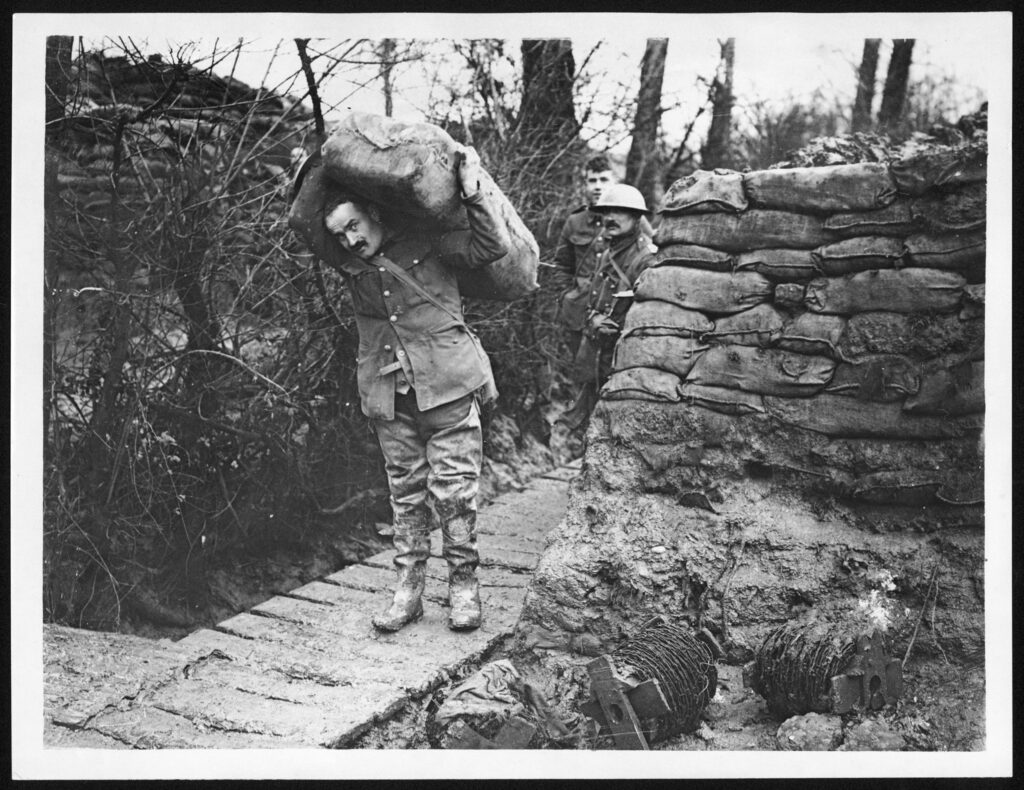
In the north, in Belgian Flanders around the city of Ypres — which British soldiers pronounced “Wipers” because they could not manage the Flemish — the ground was flat, low-lying, and saturated with water. The water table in Flanders sits just centimetres below the surface. When artillery shells destroyed the ancient drainage systems of farms and villages, and when the constant movement of millions of men, horses, and vehicles churned the ground, the entire region became a vast swamp. The mud of Flanders became the defining physical experience of the Western Front for British and Commonwealth soldiers — sucking, grey-brown, apparently bottomless mud that swallowed horses to their bellies and drowned men who fell into shell craters.
Further south, around the Somme valley and toward Verdun, the geology changed. The ground was chalk — firmer, better-drained, but riddled with deep natural caves and easily tunneled. The Germans, recognizing that they would hold their positions here indefinitely, cut deep shelters into the chalk bedrock — some going down nine metres or more — that could protect soldiers from even the heaviest artillery bombardment. This would prove catastrophic for British attackers on July 1, 1916, when a week-long bombardment failed to kill the German machine gunners sheltering far below.
In the south, near Verdun and in Alsace, the ground became more varied — hills, forests, rivers — that gave the fighting a slightly different character. The hills around Verdun, in particular, became the site of some of the most intense and costly fighting of the entire war.
The Three Stages of the Western Front
The Western Front did not look the same in 1918 as it did in 1914 or 1916. It changed — slowly, painfully, at enormous cost — through three broad stages.
Stage 1 — The Opening War of Movement (August–November 1914)
The first stage was the only period of genuine mobility on the Western Front — the opening weeks of sweeping advances and dramatic retreats that produced the Battle of the Marne and the Race to the Sea. Within four months, this stage was over. The trenches had been dug. The static war had begun.
Stage 2 — The Stalemate (1915–1917)
The second and longest stage was the grinding stalemate of the trenches — the period most people think of when they imagine the Western Front. Both sides held their positions, launched periodic major offensives that cost hundreds of thousands of lives for minimal territorial gain, and learned, slowly and at terrible cost, how to fight a new kind of war.
The major battles of this period — Second Ypres in 1915, Verdun and the Somme in 1916, Arras and Passchendaele in 1917 — defined the Western Front experience for the soldiers who lived through them. Each was launched with hopes of a breakthrough. Each ground down into attrition. Each ended with the lines barely changed and the casualties mounting toward figures that seemed impossible.
Second Ypres, in April 1915, saw the first large-scale use of poison gas on the Western Front — clouds of chlorine released from thousands of cylinders drifting toward Allied lines on the wind, causing mass panic and casualties among men who had no protection against it.
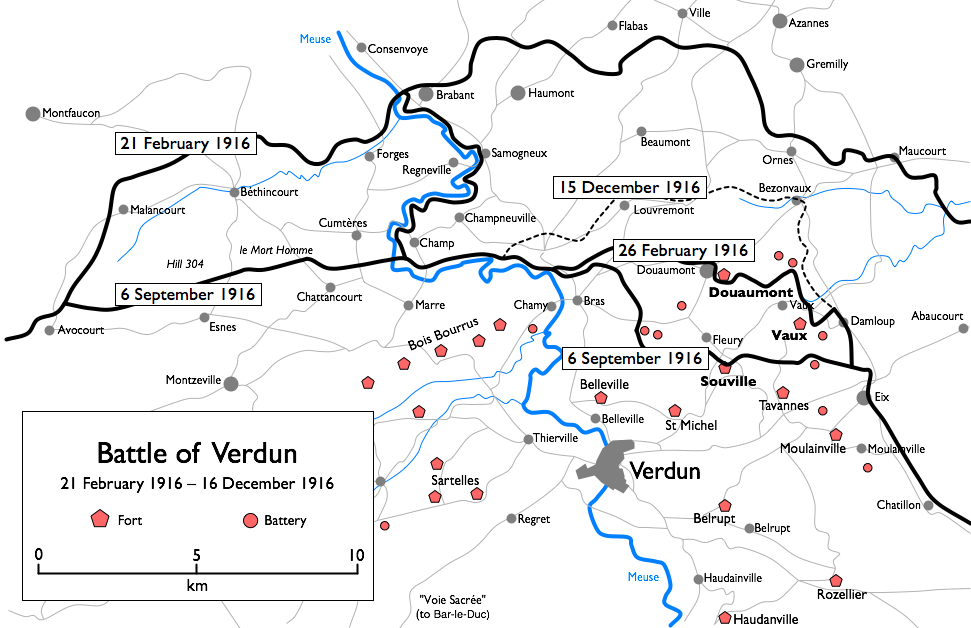
Verdun, from February to December 1916, was deliberately designed by German General Falkenhayn not to achieve a breakthrough but to kill French soldiers faster than France could replace them — to “bleed France white.” It very nearly worked. The French Army suffered approximately 400,000 casualties at Verdun. The German Army suffered a similar number. The fortress town itself changed hands multiple times. The landscape around it was so saturated with unexploded ordnance, human remains, and toxic chemicals that large areas cannot be safely farmed even today.
The Somme, from July to November 1916, was Britain’s attempt to relieve pressure on the French at Verdun. Its first day — July 1, 1916, with 57,470 British casualties — remains the bloodiest single day in British military history. The battle continued for four and a half months, consuming approximately 420,000 British and Commonwealth casualties, 200,000 French casualties, and somewhere between 400,000 and 500,000 German casualties for an advance of at most twelve kilometres.
Passchendaele — the Third Battle of Ypres, fought from July to November 1917 — has become the symbol of the Western Front at its most futile. The battle was fought in the worst possible conditions — a particularly wet autumn had turned the already waterlogged Flanders ground into an almost impassable swamp. Men and horses drowned in shell craters. Artillery pieces had to be manhandled on wooden platforms to prevent them from sinking. The advance, after three and a half months of fighting and approximately half a million casualties on both sides, measured about eight kilometres.

Stage 3 — The Return of Movement (1918)
The third stage came in 1918, when the stalemate finally broke — in both directions.
Germany’s Spring Offensive of March 1918 — Operation Michael — broke through the Allied lines with a speed and depth that had not been seen since 1914. Using new stormtrooper tactics, elite infantry bypassed strong points and drove deep into Allied rear areas, advancing faster in one day than the Somme had managed in months. For a brief, terrifying period, it appeared Germany might actually win.
The offensive ultimately failed — Germany had used up its best soldiers and could not sustain the advance. By summer, the initiative had shifted definitively to the Allies.
The Hundred Days Offensive, beginning at Amiens on August 8, 1918, was the mirror image of the German spring attack. Combined arms tactics — tanks, aircraft, artillery, and infantry working together with a coordination that had taken four years of brutal learning to develop — broke through the German lines and kept breaking through. The German Army, exhausted and undermanned, began to dissolve. Territory that had not changed hands since 1914 was retaken in weeks.
On November 11, 1918, the Armistice came into effect. The Western Front ceased to exist. The line that had killed millions of people simply stopped being a front line and became, instead, a landscape of devastation waiting to be rebuilt.
The Major Battles of the Western Front — At a Glance
The Western Front was the site of some of the largest and costliest battles in human history. Here is a summary of the most significant.
Battle of the Marne (September 1914) — The battle that stopped the German advance and made the Western Front possible. Allied victory. German forces retreat north and dig in.
First Battle of Ypres (October–November 1914) — The battle that established the Ypres Salient — a bulge in the Allied line around the city of Ypres that would be fought over for the entire war. Both sides exhausted. Lines stabilize.
Second Battle of Ypres (April–May 1915) — Germany uses poison gas for the first time on the Western Front. Allied line nearly breaks. Held at enormous cost.
Battle of Verdun (February–December 1916) — Ten months of attritional fighting around the French fortress city. Approximately 700,000 casualties combined. Neither side achieves its objectives. One of the longest and costliest battles in history.
Battle of the Somme (July–November 1916) — Britain’s largest offensive of the war. 57,470 casualties on the first day alone. Approximately 1.1 million total casualties on all sides. Tanks used in combat for the first time. Advance of twelve kilometres maximum.
Battle of Arras (April–May 1917) — British offensive coordinated with the disastrous French Nivelle Offensive. Canadian Corps captures Vimy Ridge in one of the most celebrated actions of the war. Significant early gains that grind into stalemate.
Vimy Ridge (April 1917) — Canadian Corps captures a position that British and French forces had repeatedly failed to take. Considered a defining moment of Canadian national identity.
Third Battle of Ypres — Passchendaele (July–November 1917) — The Western Front at its most extreme. Mud, rain, and half a million casualties for eight kilometres of advance.
Battle of Cambrai (November 1917) — First mass tank attack in history. 476 tanks achieve a breakthrough that surpasses anything accomplished by conventional methods — then the gains are largely lost to a German counterattack.
German Spring Offensive — Operation Michael (March–July 1918) — Germany’s last great gamble. Breaks through Allied lines using stormtrooper tactics. Advances further than any offensive since 1914. Ultimately fails to achieve a decisive result.
Hundred Days Offensive (August–November 1918) — The offensive that ended the war. Combined arms tactics break the German Army. Territory recaptured in weeks. Germany signs the Armistice on November 11.
The Human Experience — What the Western Front Felt Like
Statistics and battle names can make the Western Front feel abstract — a series of dates and casualty figures rather than a place where human beings lived and suffered and died.
The men who were there described it differently.
The smell was the first thing that struck soldiers arriving on the Western Front for the first time. Cordite from exploding shells. The sweetish, sickly smell of decaying flesh from unburied bodies in No Man’s Land. The chemical sharpness of gas drifting on the wind. Mud — not ordinary mud but the particular smell of earth saturated with years of human waste, blood, and chemicals. Men who served on the Western Front and survived the war often said they could identify the smell for the rest of their lives.
The noise was the second thing. The artillery never entirely stopped — in quiet sectors it was a distant rumble, like thunder that never ended. During offensives it became a physical sensation, a concussive force that rattled teeth and blurred vision and made conversation impossible even shouting directly into someone’s ear. Men who survived prolonged bombardments often emerged with permanent hearing damage and a flinching response to sudden loud noises that never entirely went away.
The size of the thing was something that soldiers found almost impossible to convey to people at home. The Western Front stretched 700 kilometres. A soldier at one end of it had no experience of or connection to what was happening at the other end. Each sector had its own character, its own rhythms, its own local geography and local dangers. A soldier in the relatively quiet sectors of the southern front had a completely different war from a soldier in the Ypres Salient where the fighting was nearly continuous.
And yet they were all on the same front. All part of the same enormous, grinding machine that consumed men and time with equal indifference.
The Western Front Today
The landscape of the Western Front has been rebuilt, farmed, and lived in for over a century. The cities of Ypres and Arras were reconstructed after the war — their medieval town centres rebuilt almost exactly as they had been, a deliberate choice to restore what the war had taken. Ypres today is a prosperous Belgian city with restaurants and hotels and a twice-daily ceremony at the Menin Gate, where buglers play the Last Post at 8 o’clock every evening — a tradition that has been observed every night since 1928, interrupted only during the German occupation of World War 2.
The cemeteries are everywhere. The Commonwealth War Graves Commission maintains 920 cemeteries on the Western Front — from small plots of a few dozen graves to the enormous Tyne Cot cemetery near Passchendaele, the largest Commonwealth war cemetery in the world, with nearly 12,000 graves and a memorial listing the names of a further 35,000 men who have no known grave.
Beneath the surface, the Western Front has never entirely disappeared. Belgian and French farmers still turn up unexploded shells — called the Iron Harvest — every year during ploughing season. In 2019, Belgian authorities collected and disposed of approximately 200 tonnes of World War 1 munitions. At the current rate of recovery, military historians estimate it will take another 500 years before the last shell has been found.
The ground itself remembers what happened there, even when the people who lived through it are long gone.
Why the Western Front Still Matters
The Western Front was not just the main battlefield of World War 1. It was the place where the modern world was made — in the most terrible sense of that phrase.
The industrial killing that happened there forced governments to confront the fact that modern warfare was no longer a tool of policy but a potential instrument of civilizational destruction. The millions of dead from the Western Front drove the demand for international institutions — the League of Nations, later the United Nations — that could prevent such catastrophes from happening again.
The cultural impact was equally profound. The literature, poetry, art, and film produced by and about the Western Front shaped how entire nations understood war — moving it, in the popular imagination of Britain, France, and Germany, from a test of national greatness to a synonym for futility and waste. Wilfred Owen, Siegfried Sassoon, Erich Maria Remarque — all of them wrote from the Western Front, and their work defined how a century of readers thought about the meaning of sacrifice and the nature of war.
The military lessons of the Western Front — about combined arms warfare, about the relationship between firepower and maneuver, about logistics and supply and the importance of air power — shaped every conflict that came after it.
And the Western Front’s most direct legacy was the Second World War. The unresolved resentments of the defeated powers, the flawed peace settlement of Versailles, the psychological trauma of an entire generation of European men — all of these were products of what happened along those 700 kilometres of mud and wire. The Western Front did not just consume a generation. It produced the conditions that consumed the next one too.
Which battle or location on the Western Front do you find most significant — the Somme, Verdun, Passchendaele, or somewhere else? Leave your thoughts in the comments. And if you want to understand what daily life along the Western Front was actually like for the soldiers who lived there, the full story of life in the trenches brings the human experience of this battlefield to life.
Leave a Reply